Two Unwelcome Tramways
by David F Radcliffe
Most are aware that a tramway went down Bay Street, turned right onto Beach Street, and terminated near the former London Hotel. Between 1890 and 1937, cable cars ferried people between Port Melbourne and the city using these tracks. Less well known are two controversial proposals, at the height of the gold rush, to build tramways to transport goods to and from Town Pier at the end of Bay Street. Both proposals involved wagons running on rails and drawn by horses. Both highlighted the tensions between powerful mercantile interests in Melbourne and the aspirations of Sandridge businesses and residents. The local community resisted both proposals. Neither tramway eventuated.
In 1858, the Melbourne & Hobsons Bay Railway Company proposed a tramway from their terminus at Sandridge along the beach to the publicly owned Town Pier. Locals were concerned this would create a freight monopoly for the privately owned railway from the piers to Melbourne. They were sceptical of the claim by one of the company’s directors that only the heaviest loads would be taken by the tramway and that there would be plenty of residual trade for local carriers by road from Town Pier to the city.[i]
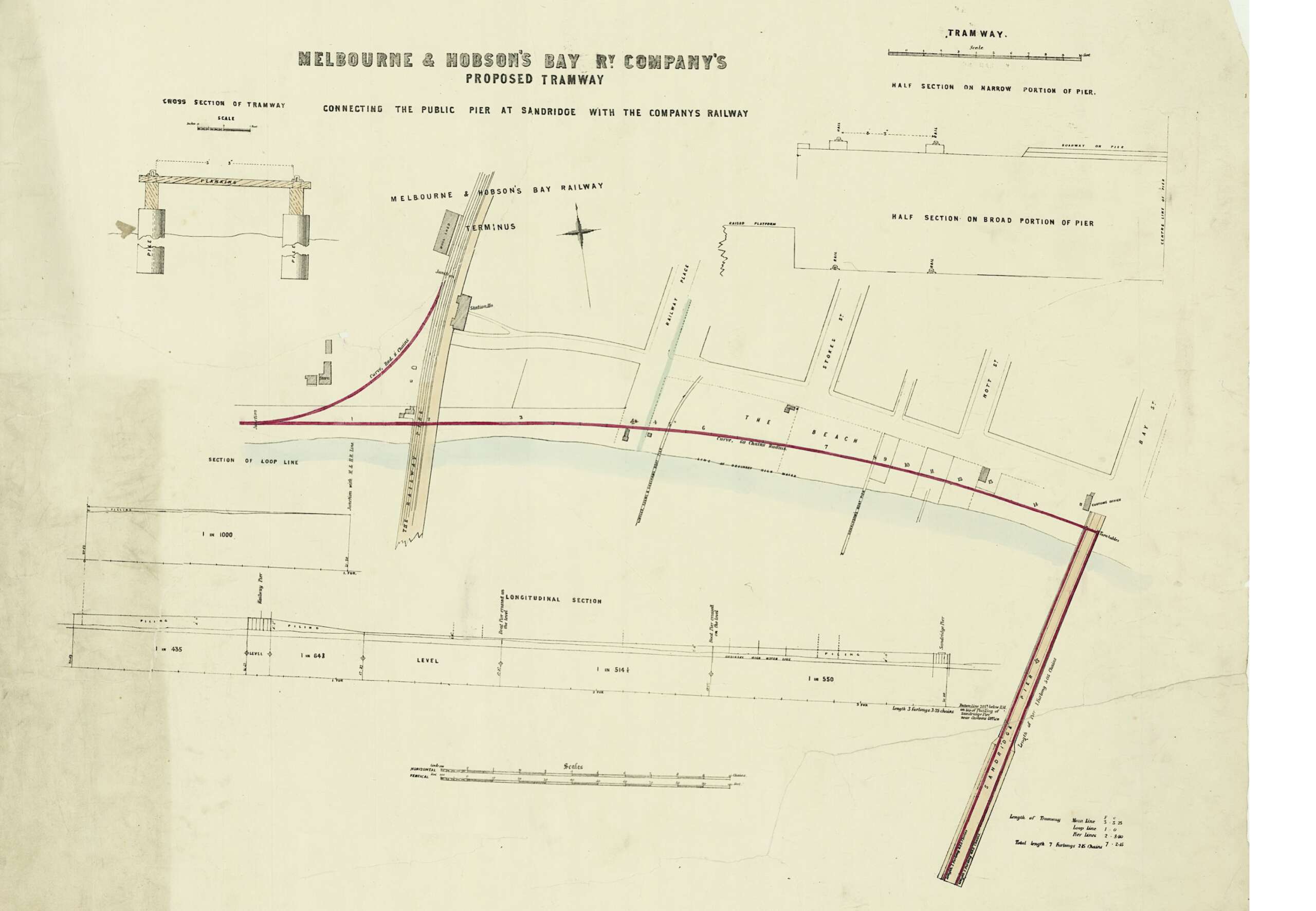
The plan above shows the proposed tramway route. Where necessary, e.g. crossing Railway Pier and in the approach to Town Pier, it would be elevated. Between the two piers, it would have traversed the approaches to the jetties of two waterfront ship chandlers, viz. Ingles, Adams & Gresham and H.D. Donaldson and Co. Turntables at the end of the Town Pier would enable the 90-degree change of direction from the shoreline tracks to those on the pier.
E.J. Crockford and others signed a request to hold a public meeting with C.M. Inglis, Alderman for the Macarthur Ward of the Melbourne City Council, the ward that encompassed Sandridge. Around 40 people attended the meeting, convened on September 23, 1858, at the Sandridge Inn. They passed a resolution describing the proposal as “detrimental and destructive to the interests of Sandridge” and called for it to be strenuously opposed. Accordingly, they resolved to send a petition to the Legislature expressing their opposition [ii]
Using the nom de plume “Nemo”, one incredulous Sandridge local wrote to the Argus.[iii]
Is it not enough that they have a water privilege such as is possessed by no other company? Is it not enough that they have in possession so large a share of national property, a great part of which is lying idle, and which they will not be able to cover in a century? The enormous frontage to Flinders-street, and the unoccupied land at Sandridge, would, if sold, realise some hundreds of thousands of pounds. It really seems as though this was not enough, and this selfish, heartless company, like a greedy ogre, having already stuffed its capacious maw with so much, seeks to stretch out its iron arms to snatch the very bread out of the mouths of its neighbours
The exasperated tone of this letter captures the local mood.
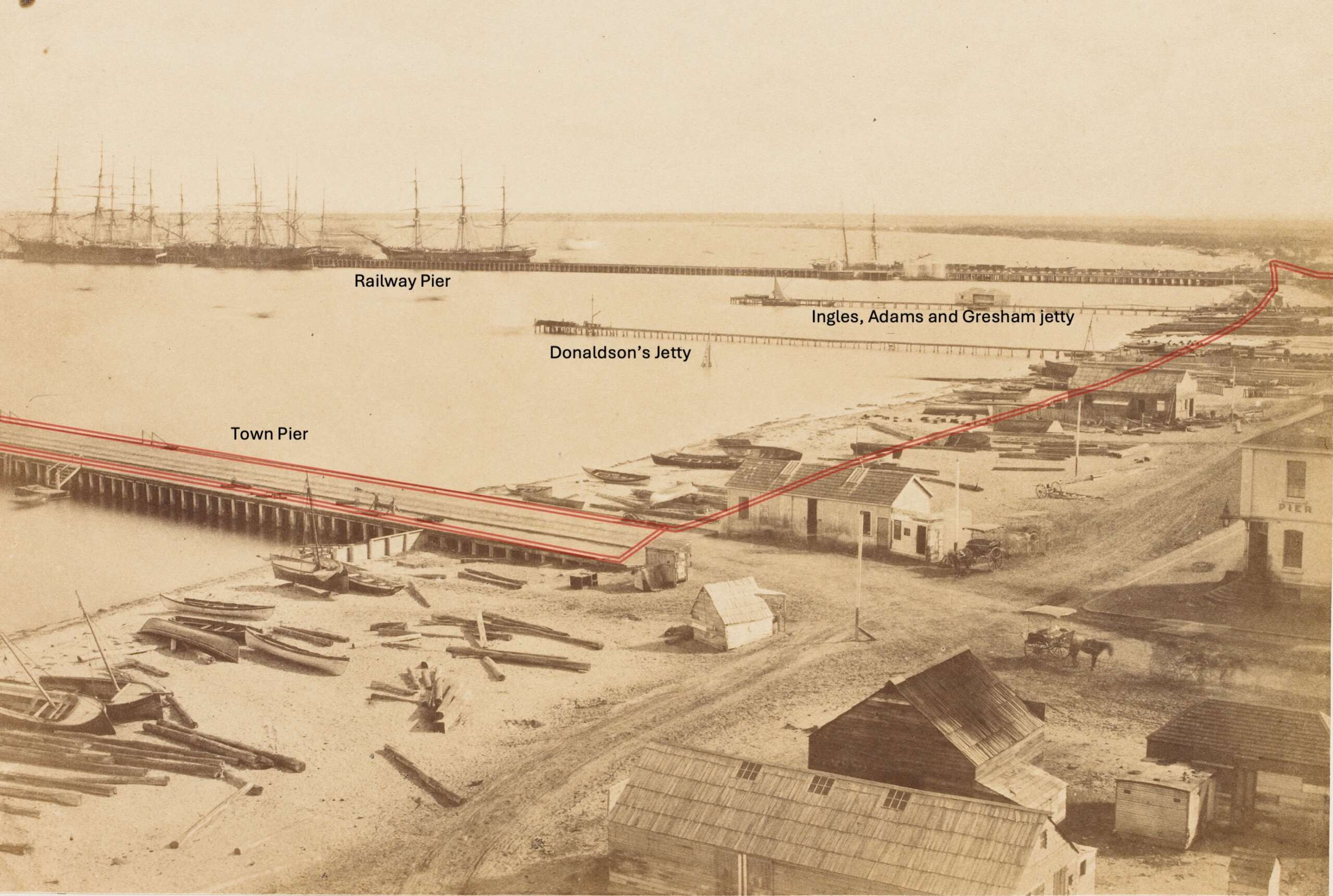
Proposed Tramway route along the Sandridge waterfront. Photo: Richard Daintree & Antoine Fauchery (1858). SLV
Notwithstanding this local opposition, the directors of the railway company approved the draft Bill to go to the Victorian Parliament. This Bill also included a proposal to build a tramway along Flinders Street between the city terminus of the Hobsons Bay line and the soon-to-be-opened Spencer Street station. Melbourne residents opposed this proposal on safety grounds, due to the number of level crossings. Consequently, the Bill was, in the words of the railway’s engineer, William Elsdon, “strangled at birth”, much to the relief of the burgess of Sandridge.[iv]
For the railway company, however, this project’s demise was one of a growing list of grievances the company presented to the Legislature in 1864. They felt unfairly treated and rebutted what they saw as exaggerated claims about the commercial benefits accruing to the company by the Act of Parliament that established this private railway.[v]
Meanwhile, Sandridge had to fend off a second, unwelcome tramway proposal in 1858. In early September, the Melbourne City Council endorsed a proposal by a private company, the Sandridge Tramway Co, for a horse-drawn tramway to run from Town Pier, along Bay Street to the city, as shown below.[vi] At the public meeting held on September 23 to discuss the railway company’s tramway along the foreshore, Alderman Ingles was adamant that speakers confine their comments to that proposal and nothing else. However, having passed the resolutions opposing the foreshore scheme, those at the meeting who were equally concerned about the Bay Street tramway forced the Alderman’s hand. Reluctantly, he convened a second public meeting the following Tuesday evening, September 28.[vii]
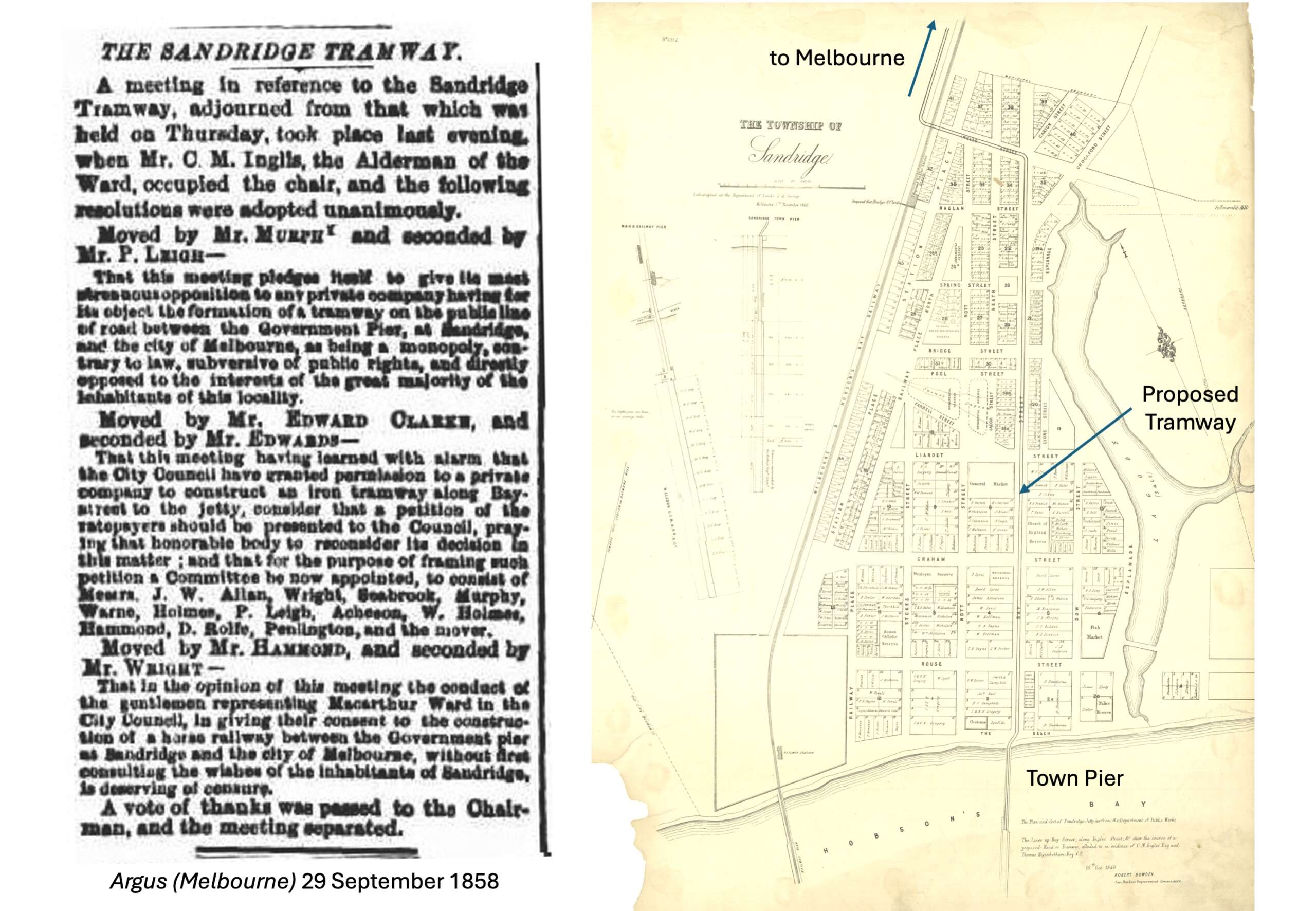
This second meeting passed a motion opposing….
…. any private company having for its object the formation of a tramway on the public line of road between the Government pier, at Sandridge, and the city of Melbourne, as being a monopoly, contrary to law, subversive of public rights, and directly opposed to the interests of the great majority of the inhabitants of this locality.
They formed a committee to draft a petition to the Melbourne Council and censured Alderman Ingles for failing to consult Sandridge residents before the Council vote.[viii] This was an especially sensitive time around local governance, with the community agitating for Sandridge to become a separate municipality. The citizens petitioned the Government in 1859, and their request was granted the following year.[ix]
Although the Sandridge Tramway Company proposal did not eventuate, many championed the idea of a publicly owned and operated tramway from Town Pier to the city. The 1860 Royal Commission on Harbour Improvements and a River and Harbour Trust recommended the construction of a stone or iron tramway from Town Pier along Bay Street to Spencer Street, Melbourne, crossing the Hobsons Bay Railway at Ingles Street, rear the Raglan Street (North Port) Station, and crossing the Upper Yarra by a swing-bridge with an opening of fifty feet.[x] This route, the same as that originally proposed by the Sandridge Tramway Company, is highlighted in red on the plan below by Robert Bowden, Secretary to the Royal Commission.
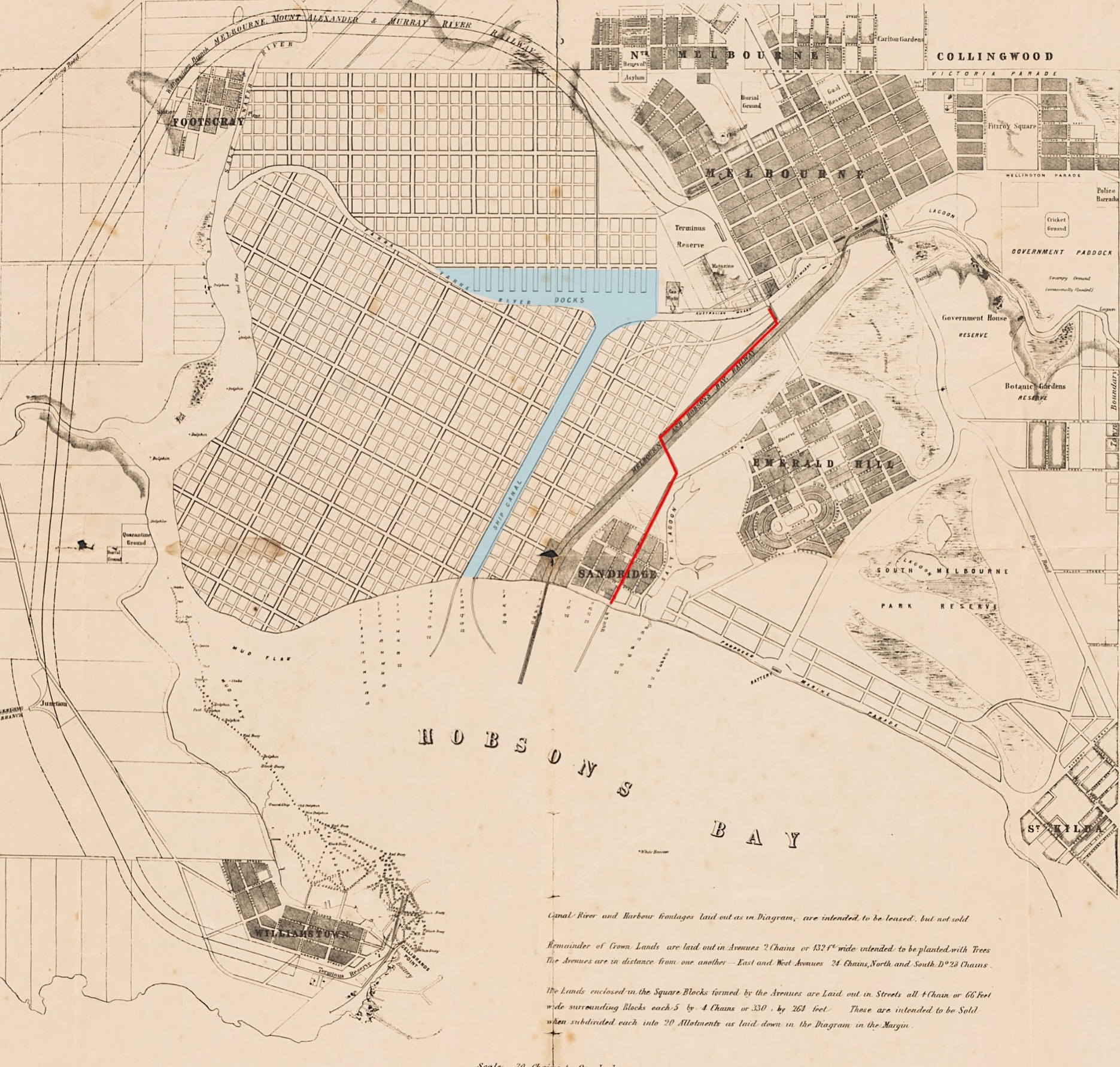
Bowden’s plan for a ship canal direct from Hobsons Bay to the city (shown in blue), together with his concept for subdividing Fishermans Bend and the West Melbourne swamp on either side of the original course of the Yarra, was one of many imaginative proposals submitted at the time.[xi] He is responsible for the tramway down Bay Street appearing on the well-known 1860 Sandridge map (and subsequent maps that were based on it).
During the early 1860s, correspondents from Sandridge filled copious column inches in the Argus with letters to the editor extolling the potential of such a tramway given the state of the roads.[xii] Penned mostly by local cartage contractors, they highlighted the advantages of wagon haulage compared to the railway.[xiii] The letter writers signed with their initials; the most vociferous was “R.W.C.”[xiv] Most likely, this was Robert Walter Carrick, local carrier, and later a Port Melbourne councillor and mayor (1872-73).
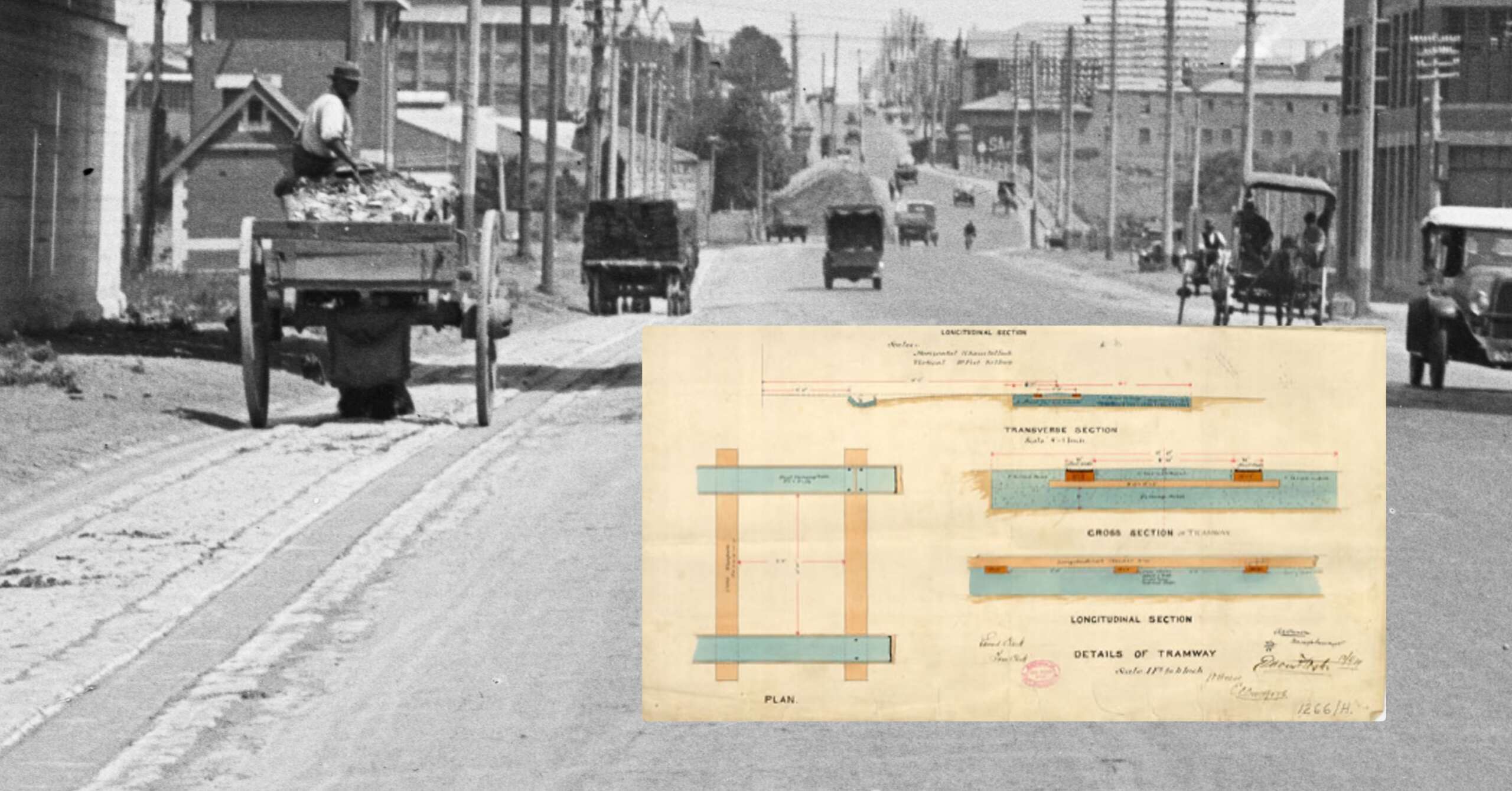
Unfortunately, they had to wait a couple of decades before plateways, a type of tramway, were installed along City Road and Ingles Street to support heavily laden, horse-drawn wagons.[xv] As illustrated above, plateways comprised a pair of flat, steel tracks flush to the road surface, supported by a system of buried sleepers.
As the dust settled on these two unwelcome tramway proposals, and before the Royal Commission reported, a third tramway concept appeared. Put forward by the Sandridge Pier, Dock and Tramway Company in 1859, it was part of the long-held dream of Sandridge Lagoon becoming a major boat harbour. But that is another story.
[i] Nancy U’Ren and Noel Turnbull (1983), A History of Port Melbourne, Oxford University Press, pp. 31-34.
[ii] 1858 ‘PROPOSED TRAMWAY AT SANDRIDGE.’, The Argus (Melbourne, Vic. : 1848 – 1957), 24 September, p. 5. , viewed 28 Jul 2026, http://nla.gov.au/nla.news-article7301641
[iii] 1858 ‘THE MELBOURNE AND HOBSON’S BAY RAILWAY.’, The Argus (Melbourne, Vic. : 1848 – 1957), 21 September, p. 1. (Supplement to the Argus), viewed 30 Jul 2026, http://nla.gov.au/nla.news-article7301430
[iv] 1862 ‘THE CENTRAL RAILWAY TERMINUS.’, The Age (Melbourne, Vic. : 1854 – 1954), 6 December, p. 7. , viewed 30 Jul 2026, http://nla.gov.au/nla.news-article154967960
[v] 1864 Statement of the claims of the Melbourne & Hobson’s Bay Railway Company: to the consideration of the Legislature in the matter of wharfage rates, Wilson and McKinnon Printers, 74 pages.
[vi] 1858 ‘CITY COUNCIL.’, The Argus (Melbourne, Vic. : 1848 – 1957), 7 September, p. 5. , viewed 30 Jul 2026, http://nla.gov.au/nla.news-article7300622
[vii] 1858 ‘PROPOSED TRAMWAY AT SANDRIDGE.’, The Argus (Melbourne, Vic. : 1848 – 1957), 24 September, p. 5. , viewed 28 Jul 2026, http://nla.gov.au/nla.news-article7301641
[viii] 1858 ‘THE SANDRIDGE TRAMWAY.’, The Argus (Melbourne, Vic. : 1848 – 1957), 29 September, p. 4. , viewed 31 Jul 2026, http://nla.gov.au/nla.news-article7301924
[ix] Petition under the Municipality Act, Sandridge, Victorian Government Gazette, No. 189, 2nd December 1859, p. 2610.
[x] Report of the Royal Commission on Harbor Improvements and River and Harbor Trust, 1860, Public Record Office Victoria.
[xi] Bowden’s plan was one of many submitted to the Royal Commission featuring av“straight-cut” canal.
[xii] 1863 ‘CART v. RAILWAY BETWEEN SAND RIDGE AND MELBOURNE.’, The Argus (Melbourne, Vic. : 1848 – 1957), 26 June, p. 7. , viewed 01 Aug 2026, http://nla.gov.au/nla.news-article6486852
[xiii] 1863 ‘CART V. RAILWAY BETWEEN HOBSON’S BAY AND MELBOURNE.’, The Argus (Melbourne, Vic. : 1848 – 1957), 1 June, p. 6. , viewed 01 Aug 2026, http://nla.gov.au/nla.news-article6486206
[xiv] 1863 ‘CART V. RAIL AND CART BETWEEN SANDRIDGE AND MELBOURNE.’, The Argus (Melbourne, Vic. : 1848 – 1957), 2 July, p. 7. , viewed 31 Jul 2026, http://nla.gov.au/nla.news-article6487010
[xv] Phil Richard (2019), Plateways around Melbourne: Part 2 – Sand, Swamp, Clay and Quarry, Light Railways, No. 267, June, pp. 3-16.