John Pickles: Shipwright & Smithy
by David F Radcliffe
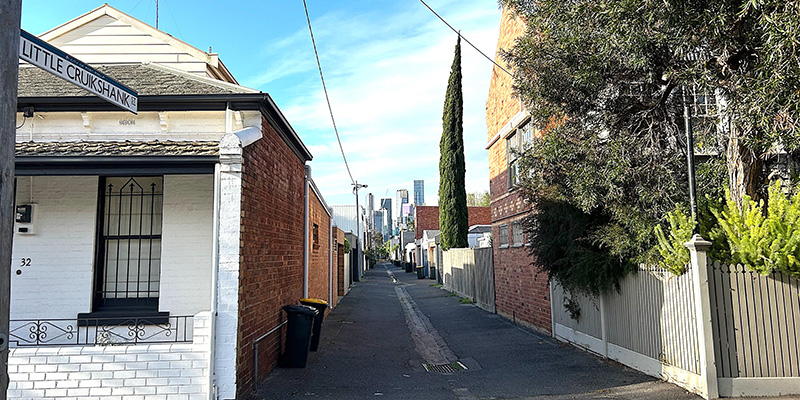
John Pickles, after whom Pickles Street is named, is forever associated with his ‘kidnapping’ in August 1862. The recently formed Borough Council was scheduled to meet to elect a new mayor and many favoured John Pickles over other candidates. However, he was not interested in the role. To make sure he did not attend the meeting to decide the mayor, at which he would have declined the nomination, two men lured him out onto Hobsons Bay on a pretext and detained him there. In his absence, Pickles was elected by one vote, but he refused to serve. The incident was reported in sensational terms with newspapers publishing detailed accounts of witnesses during the trial of his two abductors.[i]
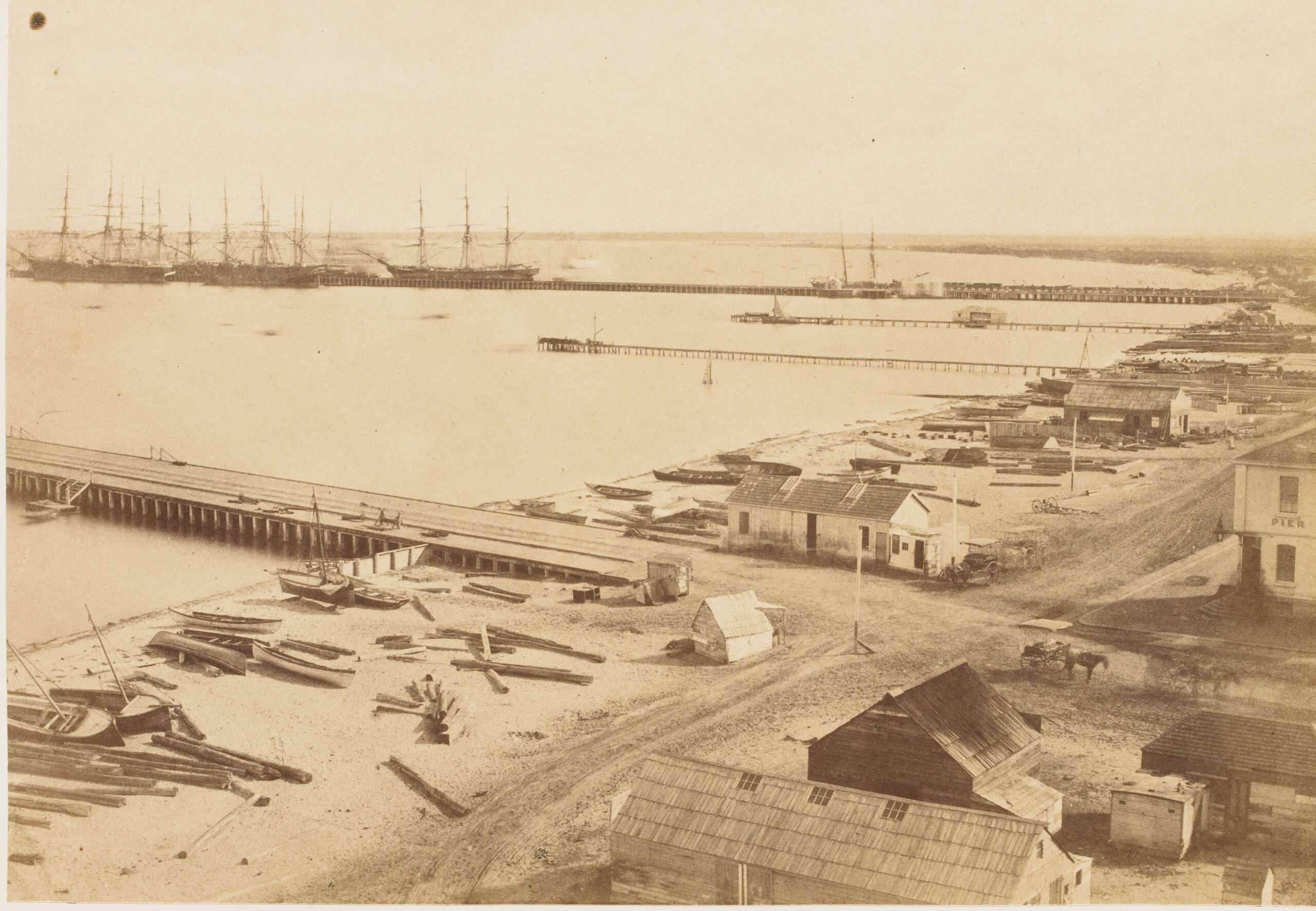
Amusing as this attempt to pervert the course of local politics is in hindsight, the full arc of John Pickles’ life tells us much more about the dynamics of 19th century Sandridge. Born in Leeds, Yorkshire in 1824, John Pickles was an only child.[ii] He apprenticed as a shipwright there, a place not normally associated with shipbuilding.[iii] For unknown reasons, Pickles emigrated in 1852, arriving in Melbourne in October as gold rush fever was taking hold.[iv] Within a year, he had established a ship and boat building business, John Pickles & Co, on the foreshore at Sandridge near the Pier Hotel.[v]
The ensuing decade was good to John Pickles. Now thirty, he married Elizabeth Turton (aged 31) at St Paul’s Church in Swanson Street at the start of 1855.[vi] Like John, Elizabeth hailed from Leeds and their nuptials were witnessed by her cousin, Charlotte, and husband, Benjamin.[vii] Although neither of his parents could read or write, Pickles developed a love of Shakespeare.[viii] His admiration for the bard was reflected in the second names given to the children Elizabeth delivered: Harriet Lavinia (1855), Joshua Orlando (1858) and George Horatio (1862).[ix] Their first names, Harriet, George and Joshua honoured Elizabeth’s mother and father and John’s father respectively.
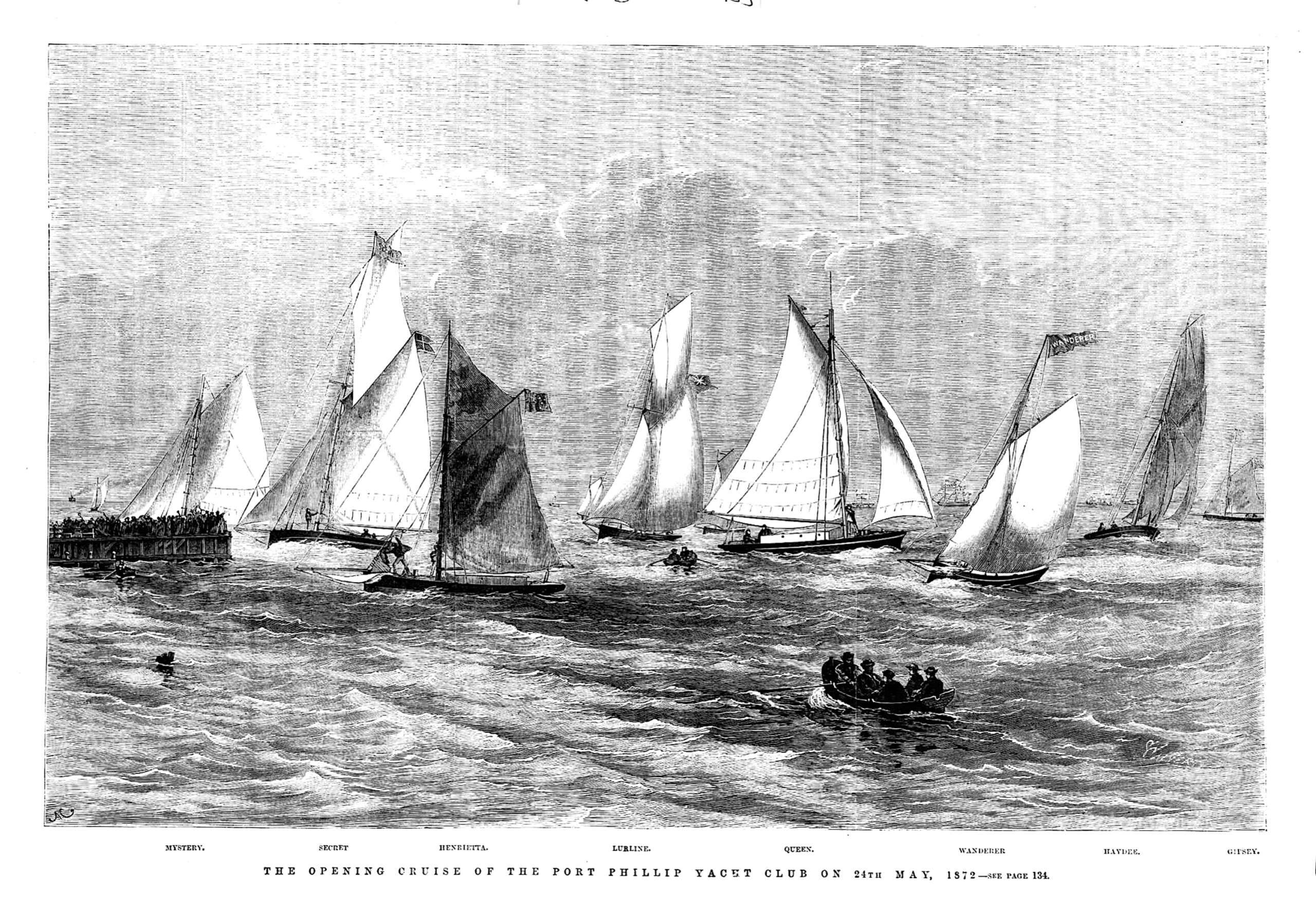
Pickles became part of the commercial fabric of Sandridge. In 1856, he was the Sandridge representative on the four-man committee that convened the Annual General Meeting of the Master Shipwrights held at James Garton’s Pier Hotel, bringing together members from Sandridge, Williamstown and Melbourne.[x] Records of the many vessels Pickles built are lost, with the exception of the yacht Mystery, an eleven ton cutter he constructed between January and June 1858. She raced in regattas on Hobsons Bay and Corio Bay for several decades winning first prizes of one hundred Guineas (£110) for her owners on at least two occasions. Following one of these victories, the Argus wrongly attributed the construction of the Mystery to one of Pickles’ employees, an error he was quick to correct in a letter to the editor.[xi]
In August 1860, as Sandridge transitioned to being an independent municipality, Pickles was nominated as a prospective councillor, but failed to get sufficient votes.[xii] Undeterred, he tried again and was elected unopposed in July 1861.[xiii]A year later, his infamous ‘kidnapping’ took place. Although annoyed by the whole incident, Pickles remained on council and was re-elected again in 1864. In January 1865, Pickles Street was gazetted together with other streets east of Sandridge Lagoon.[xiv] The creation of Pickles Street gave form and function to the imaginary line in the sand that defined the east-west boundary between Emerald Hill (South Melbourne) and Sandridge.
Pickles now styled himself as a ‘shipwright and smith”, i.e. a blacksmith who forges iron parts for ships. Around 1863, the family moved into a comfortable five room brick cottage on Stokes Street, between Rouse and Grahams Streets, purchased with the aid of a £200 mortgage from the South Melbourne Building Society. Prior to this they had been renters. However, their world was about to fall apart.
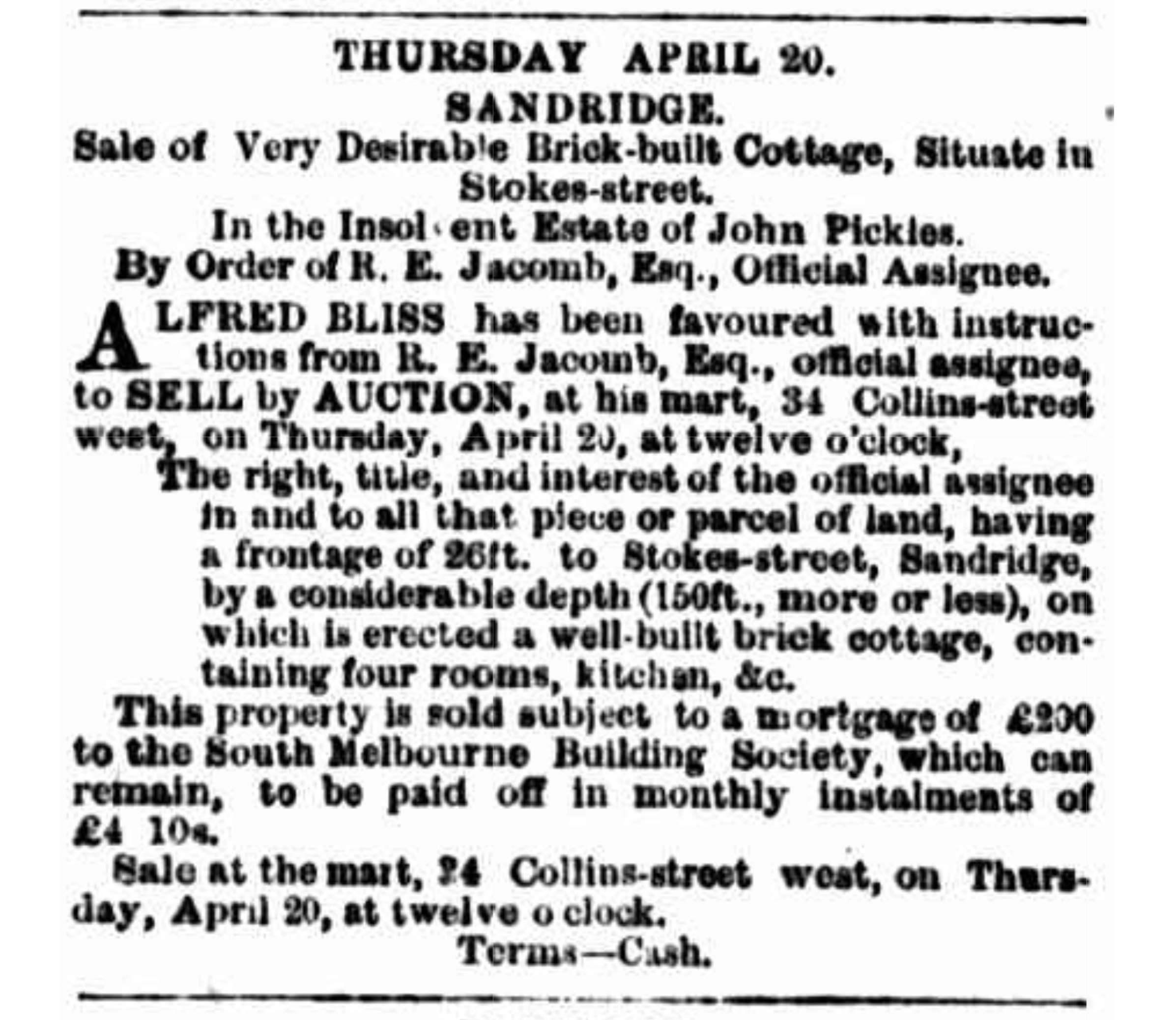
In March 1865, just two months after Pickles Street was gazetted, John Pickles was declared insolvent.[xv] The reasons were an adverse judgement in the County Court, illness in the family and bad debts. Consequently, their home in Stokes Street that he had worked hard to achieve was auctioned off. As a bankrupt he was required to resign from the Council. The Pickles family moved to a rented house in Station Place where John Arthur was born in February 1866. Sadly, he died three months later and soon after Elizabeth Pickles passed away having been in poor health for some time.[xvi]
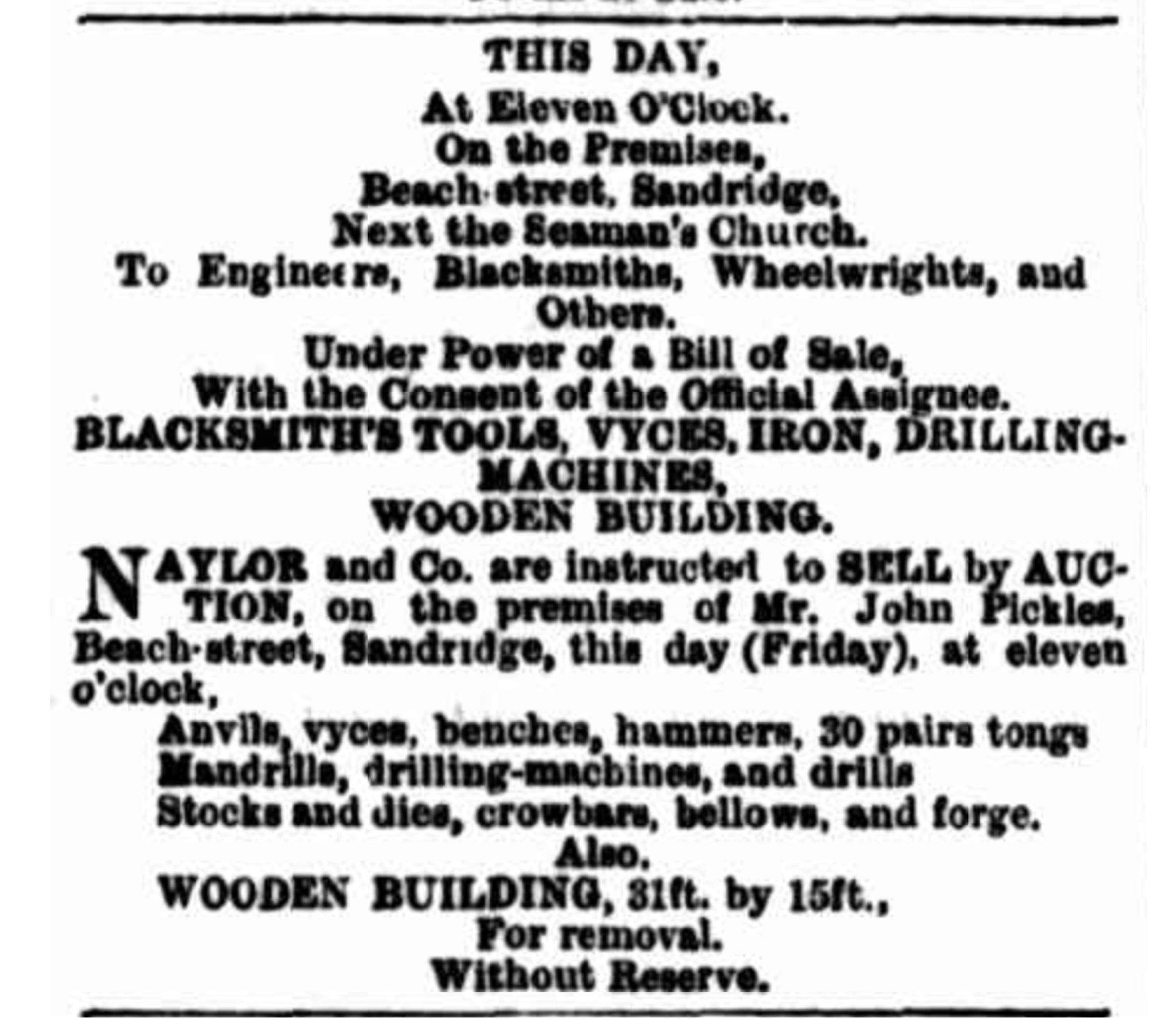
Grief-stricken, John Pickles had three children to raise – Harriet (aged 10), Joshua (aged 7) and George (aged 3) – plus a business to rebuild having received his insolvency discharge. However, due to a falling off in trade, further illness in the family and the ongoing impact of Elizabeth’s death, Pickles was declared insolvent again in January 1870. To pay off his debts, all his black-smithing tools plus a wooden shed he had on Beach Street were auctioned.[xvii] While insolvency was not uncommon in those days, the public spectacle of having first your home and soon after your tools of trade compulsorily sold must have been humiliating.
Notwithstanding what he had been through, in April 1870 John Pickles delivered an erudite lecture titled “Ironworkers, Innovators and Engineers” at the Mechanics’ Institute in Emerald Hill. He explored the development of the tools and machinery used in over three centuries leading up to the present time, highlighting the names of many famous machine and tool makers. In his presentation, Pickles also expressed his conviction that the future prosperity of the colony depended on industries making things based on coal and iron rather than (gold) mining. His talk was frequently interrupted by applause from the audience, and he planned to say more at a future meeting at Trades Hall, Melbourne.[xviii]
Whether Pickles, now in his mid-forties, attempted to revive his blacksmithing business is unclear. For a time in the 1870s he worked at Robert Kennedy’s ship building yard on Yarra Edge.[xix] Then tragedy struck again in April 1880 when his only daughter Harriet, aged just twenty four, passed away at the small brick cottage the family now rented in Reserve Place.[xx] A few years later, his son, Joshua Orlando, known locally as Orlando, was arrested for being drunk and disorderly in Bay Street. While in the police cell he destroyed the urinal.[xxi] Orlando collapsed and died at the Station Club Hotel in February 1890, just shy of his thirty second birthday. His work mates from Buchanan’s Foundry, with the assistance of the hotel proprietor, paid for Orlando’s funeral.[xxii]
By now, John Pickles, was unable to work and in need of local charity.[xxiii] In May 1890, he was admitted to the Benevolent Asylum in North Melbourne.[xxiv] Pickles had chronic knee ulcers, was partly paralysed and had no family to care for him. He had lost contact with his one surviving son, George, who moved to Sydney some years earlier.[xxv] Pickles passed away at the Asylum in October 1894, aged 70.[xxvi]
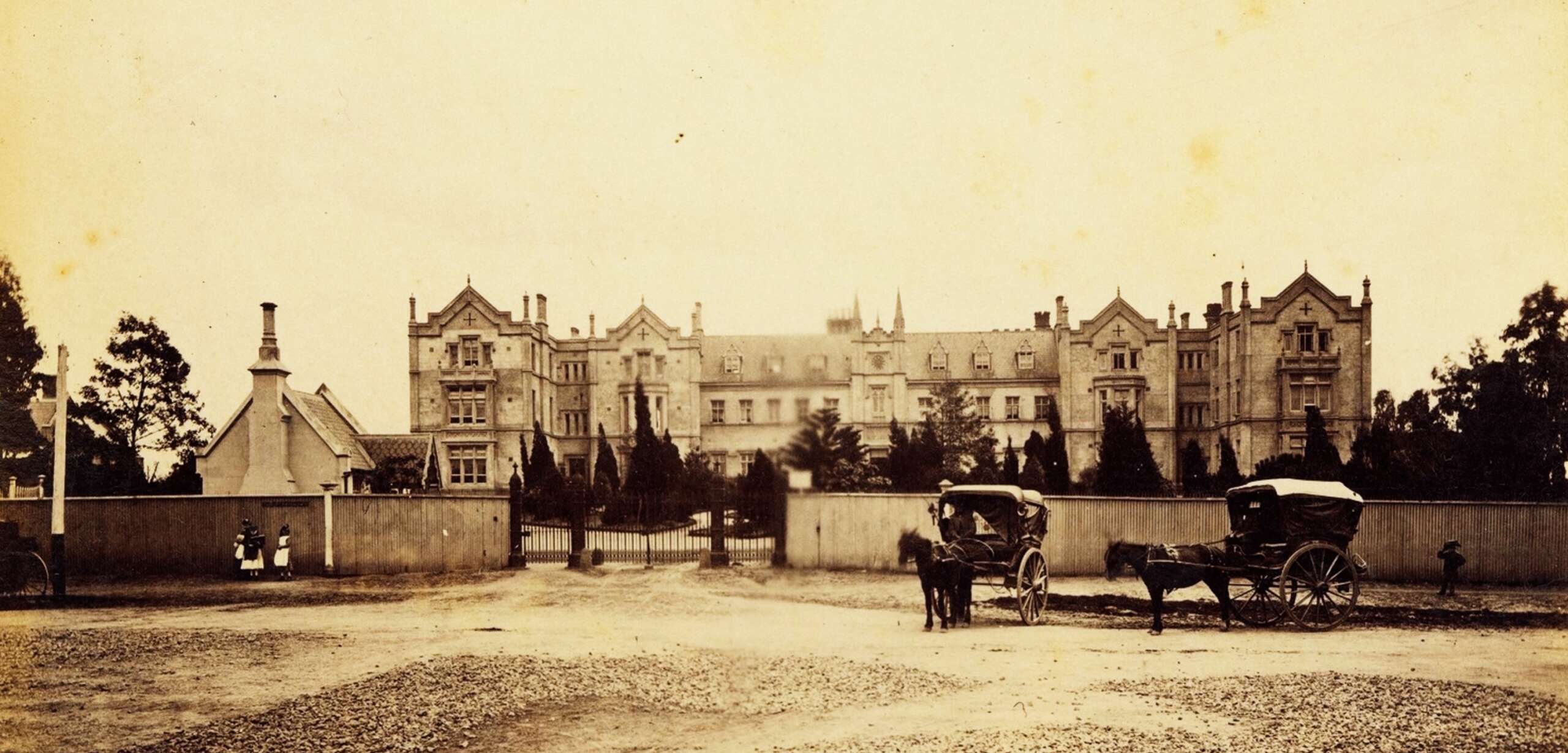
It is noteworthy that the person who admitted John Pickles to the North Melbourne Asylum was James Plummer, the son of Dr Andrew Plummer who became the mayor following the infamous kidnapping incident back in 1862. Dr Plummer was the person Pickles endorsed as mayor.
John Pickles was a multifaceted character. A skilled, enterprising and versatile craftsman, he was the first local employer to grant an eight-hour day to his workers.[xxvii] He demonstrated fortitude and resilience. Able to enumerate the stars and planets, Pickles also had an extensive knowledge of the Scriptures. At times irascible and obstinate, he was convivial company at Chequers Inn (now the Bay & Bridge hotel) where he would quote “anything and everything”. Many years later, John Pickles was still remembered as “a wonderful man in many ways”.[xxviii]
[i] 1862 ‘CRIMINAL SESSIONS.’, The Argus (Melbourne, Vic. : 1848 – 1957), 20 August, p. 6. , viewed 11 Nov 2025, http://nla.gov.au/nla.news-article5720534
[ii] The 1841 and 1851 Censuses for England and Wales list John Pickles as the only person, child and then adult, resident with his parents.
[iii] Although Leeds is an inland town, it had boat building yards servicing the Leeds to Liverpool Canal and a sloop building yard. (Communication Leeds to Liverpool Canal Society).
[iv] The passenger list for the Hibernia has John Pickles’ trade as (stone)mason.
[v]1853 ‘Advertising’, The Argus (Melbourne, Vic. : 1848 – 1957), 18 November, p. 2. , viewed 14 Nov 2025, http://nla.gov.au/nla.news-article4799662
[vi] This is the original St Paul’s Anglican Church that preceded the cathedral.
[vii] 1855 ‘Family Notices’, The Argus (Melbourne, Vic. : 1848 – 1957), 4 January, p. 4. , viewed 12 Nov 2025, http://nla.gov.au/nla.news-article4802649
[viii] 1935 ‘RE-LIVING THE EARLY DAYS.’, The Age (Melbourne, Vic. : 1854 – 1954), 26 January, p. 6. , viewed 14 Nov 2025, http://nla.gov.au/nla.news-article205867216
[ix] Birth Deaths and Marriages Victoria.
[x]1856 ‘Advertising’, The Argus (Melbourne, Vic. : 1848 – 1957), 22 August, p. 3. , viewed 14 Nov 2025, http://nla.gov.au/nla.news-article7135281
[xi]1861 ‘SANDRIDGE REGATTA.’, The Argus (Melbourne, Vic. : 1848 – 1957), 11 January, p. 5. , viewed 14 Nov 2025, http://nla.gov.au/nla.news-article5696572
[xii]1860 ‘SATURDAY, AUGUST 4, 1860.’, The Argus (Melbourne, Vic. : 1848 – 1957), 4 August, p. 4. , viewed 14 Nov 2025, http://nla.gov.au/nla.news-article5687322
[xiii] 1861 ‘TUESDAY, JULY 30, 1861.’, The Argus (Melbourne, Vic. : 1848 – 1957), 30 July, p. 4. , viewed 15 Nov 2025, http://nla.gov.au/nla.news-article5702512
[xiv] These included Johnson Street, Cruikshank Street, Esplanade East, and the eastern extensions of Rouse, Graham, Bridge and Spring Streets. Government Gazette No. 7, Friday 20 January, 1865, p. 133.
[xv]1865 ‘LAW REPORT.’, The Argus (Melbourne, Vic. : 1848 – 1957), 29 March, p. 1. (Supplement to The Argus), viewed 14 Nov 2025, http://nla.gov.au/nla.news-article5735765
[xvi]1866 ‘Family Notices’, The Argus (Melbourne, Vic. : 1848 – 1957), 26 May, p. 8. , viewed 14 Nov 2025, http://nla.gov.au/nla.news-article5763531
[xvii]1870 ‘Advertising’, The Argus (Melbourne, Vic. : 1848 – 1957), 21 January, p. 2. , viewed 14 Nov 2025, http://nla.gov.au/nla.news-article5810331
[xviii] 1870 ‘THE NEWS OF THE DAY.’, The Age (Melbourne, Vic. : 1854 – 1954), 16 April, p. 2. , viewed 14 Nov 2025, http://nla.gov.au/nla.news-article189328738
[xix] 1932 ‘(To the Editor.)’, The Record (Emerald Hill, Vic. : 1881 – 1957), 7 May, p. 8. , viewed 15 Nov 2025, http://nla.gov.au/nla.news-article164466504
[xx] 1880 ‘Family Notices’, The Age (Melbourne, Vic. : 1854 – 1954), 1 May, p. 1. , viewed 15 Nov 2025, http://nla.gov.au/nla.news-article202145480
[xxi] 1886 ‘PORT MELBOURNE POLICE COURT.’, Standard (Port Melbourne, Vic. : 1884 – 1914), 23 October, p. 2. , viewed 15 Nov 2025, http://nla.gov.au/nla.news-article164934225
[xxii] 1890 ‘Items of News.’, Standard (Port Melbourne, Vic. : 1884 – 1914), 22 February, p. 2. , viewed 15 Nov 2025, http://nla.gov.au/nla.news-article164431253
[xxiii] 1889 ‘EXCELSIOR.’, Standard (Port Melbourne, Vic. : 1884 – 1914), 6 July, p. 3. , viewed 15 Nov 2025, http://nla.gov.au/nla.news-article164426332
[xxiv] John Pickles, Records of the Melbourne Benevolent Asylum, MS F Box 626/4 – Register of applicants and inmates, male and female arranged by date of admission. Volume III, 1873 May – 1890 August, Folio 168.
[xxv] 1893 ‘Items of News.’, Standard (Port Melbourne, Vic. : 1884 – 1914), 5 August, p. 2. , viewed 16 Nov 2025, http://nla.gov.au/nla.news-article165164863
[xxvi] The official records list his age 72 years.
[xxvii] U’Ren, N and Turnbull, N. A History of Port Melbourne, Oxford University Press, 1983, p. 164.
[xxviii] 1931 ‘PROMINENT CITIZENS OF PORT MELBOURNE’, The Record (Emerald Hill, Vic. : 1881 – 1957), 7 November, p. 8. , viewed 15 Nov 2025, http://nla.gov.au/nla.news-article164960602