W.H. Hansom: Aerial Artist
by David F Radcliffe
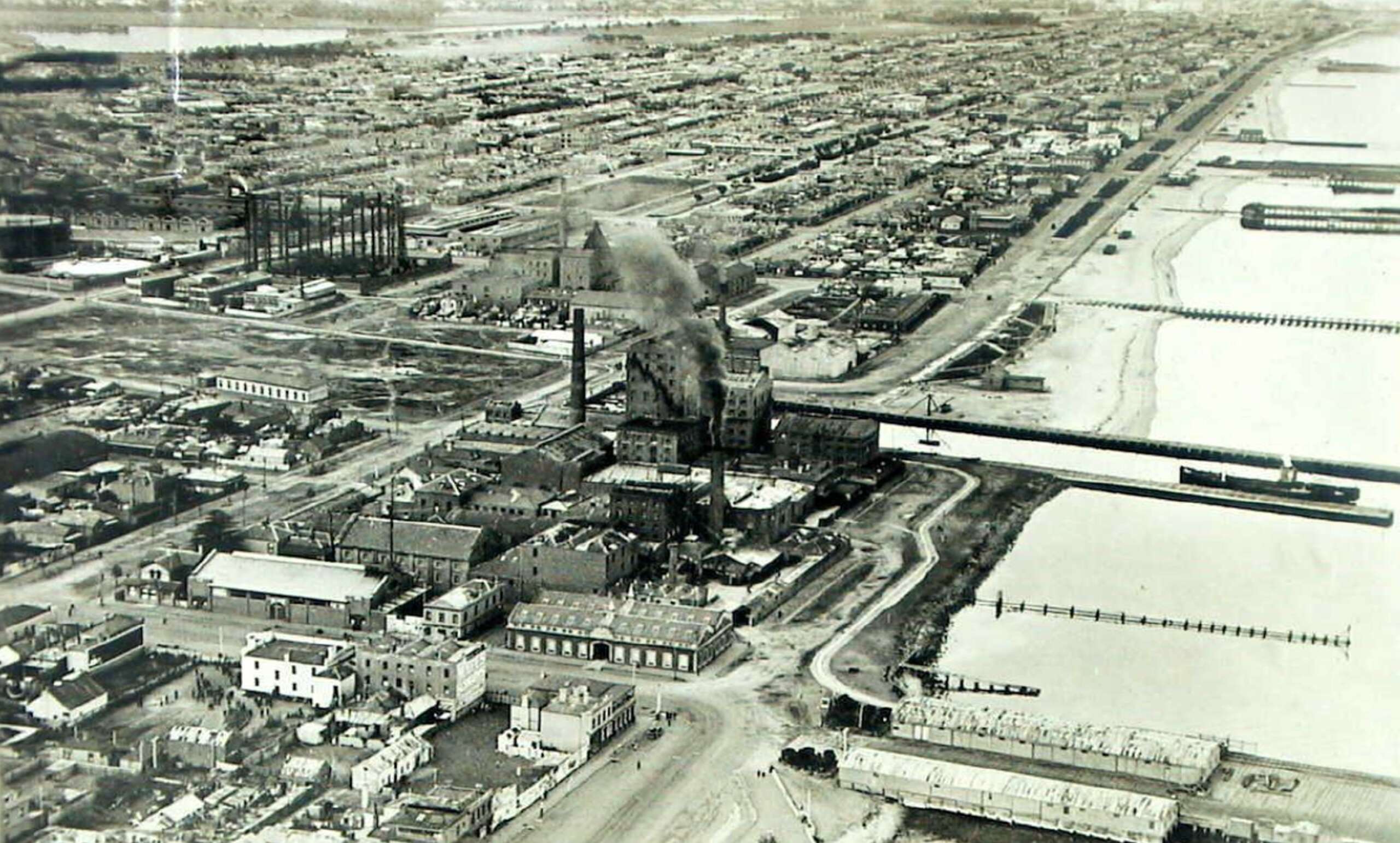
W.H. (Bill) Hansom created countless aerial photos of Melbourne and surrounds in the aftermath of WW1. He gave the public a new perspective on familiar places, streetscapes, landscapes, and major sporting events.[1] His aerial photos of the Port Melbourne foreshore are an invaluable record of developments here during the interwar years. Describing himself as an “aerial artist”, Hansom was very aware of the value of the photos he took, often registering them for copyright protection. One example is the classic scene below taken in 1920 which he titled “Port Melbourne and Albert Park from the Air”.[2]
Born William Herbert Hansom in Newcastle-upon-Tyne in 1862, he had an adventurous early life. After apprenticing as a wool classer in Bradford, he went to sea aged 19, surviving gales, ice sheets and a mutiny on a windjammer on the trans-Atlantic run between Quebec and Newcastle.[3] Hansom came to Australia in the 1880s, where he returned to his trade as a wool classer before reinventing himself as a sports journalist. In 1896, aged 34, he married twenty-one-year-old Lilly Percy. They had three children, Gladys, Ina and William.
During the 1890s and early 20th century, Bill Hansom was admired for his abilities at Manders’ Telegram Agency dispatching hundreds of sporting results.[4] Friends and colleagues extolled his manual skills as a wood turner and cabinetmaker. Hansom also made billiard tables and developed a contrivance to align billiard balls.[5] His mechanical aptitude was attributed to him being a nephew of the famous architect Joseph Hansom, inventor of the Hansom safety cab.[6] But Bill’s abiding passion was photography, a hobby he honed into a craft over several decades with his work being published and exhibited. For example, the Weekly Times published his photo “Morning Mists” in 1916, shown below.[7]
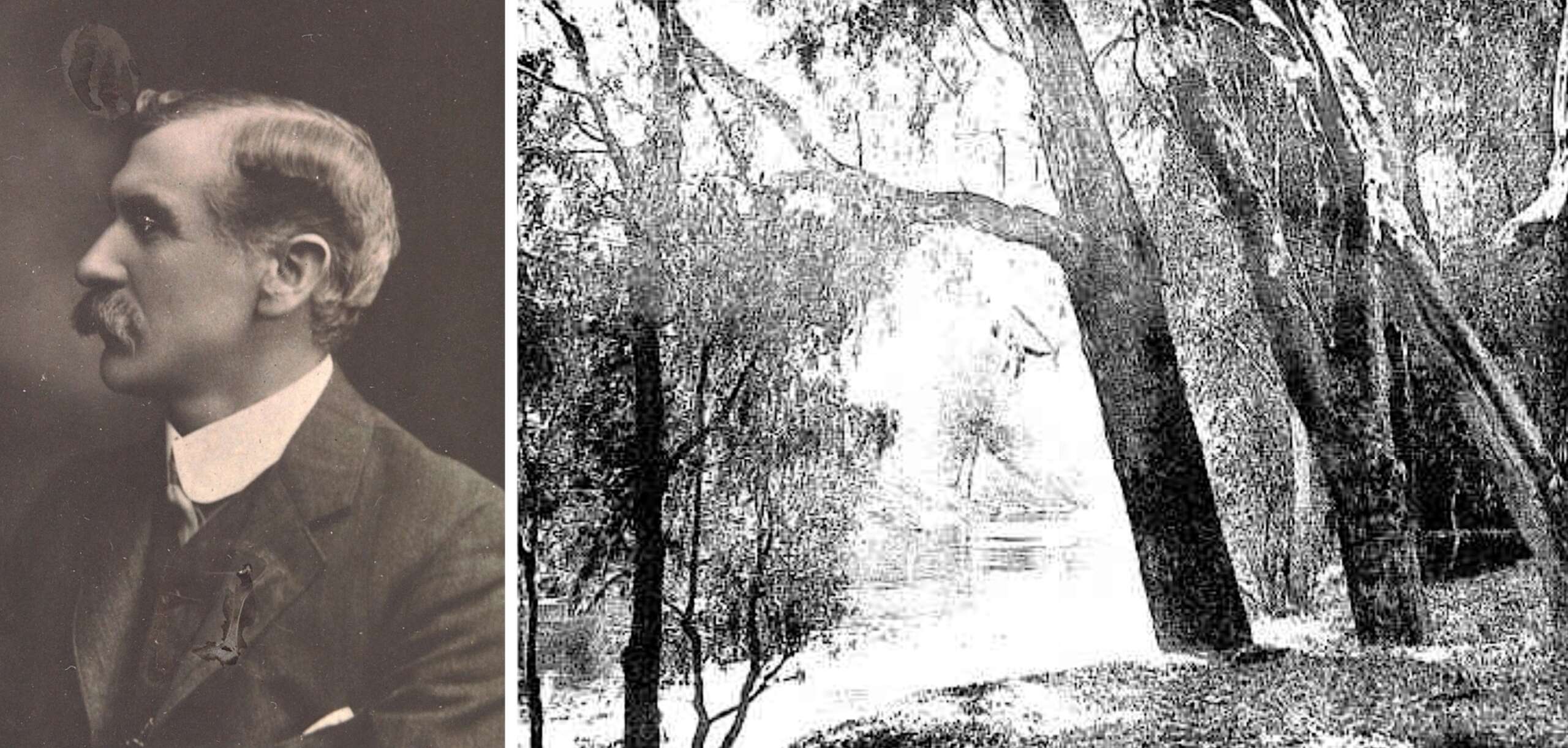
In his late fifties, Hansom turned his hobby into a business, taking aerial photos for newspapers and later survey work for government agencies and businesses. He relied on the skills of local pilots, pioneers of commercial aviation, who offered joy rides, aerial advertising and mail services flying planes that were surplus to requirements after the war. Initially he worked with R.G. Carey whose Melbourne Air Services opened in 1920 on Fishermans Bend at the end of Graham Street, just beyond Williamstown Road.[8] The following image of Carey, in his Maurice Farman Shorthorn was snapped by Hansom in the early 1920s.
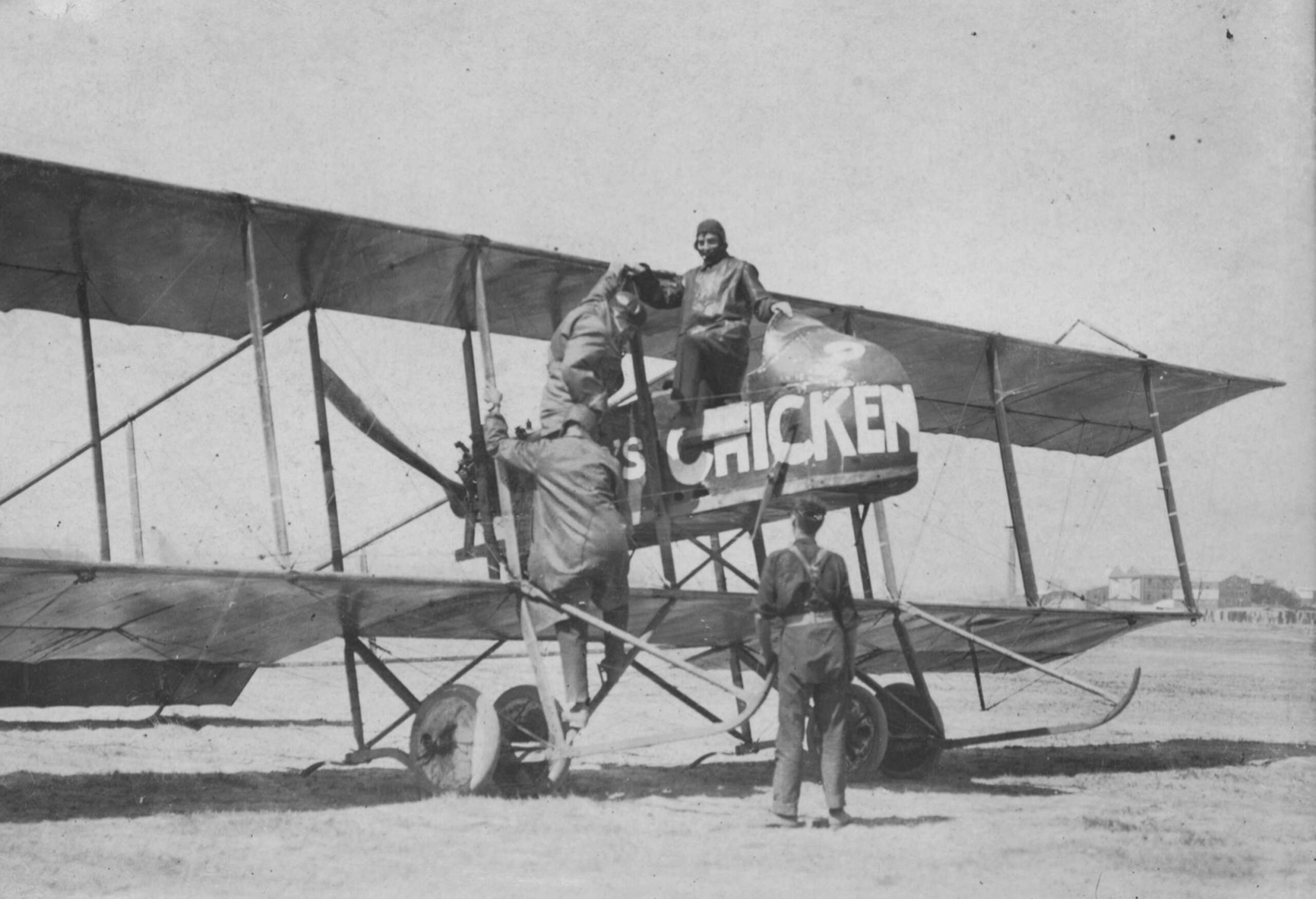
Around 1924, Hansom teamed up with Major Harry Shaw of the Shaw-Ross Aviation and Engineering Co whose aerodrome was located along the foreshore of Fishermans Bend, approximately where Batman Rd intersects with The Boulevard today. He used the workshop facilities there to modify his camera enabling him to take up to four photographs per minute. The images were always sharp as he could instantly alter the focus to suit altitudes between 6000ft and 25ft.[9]
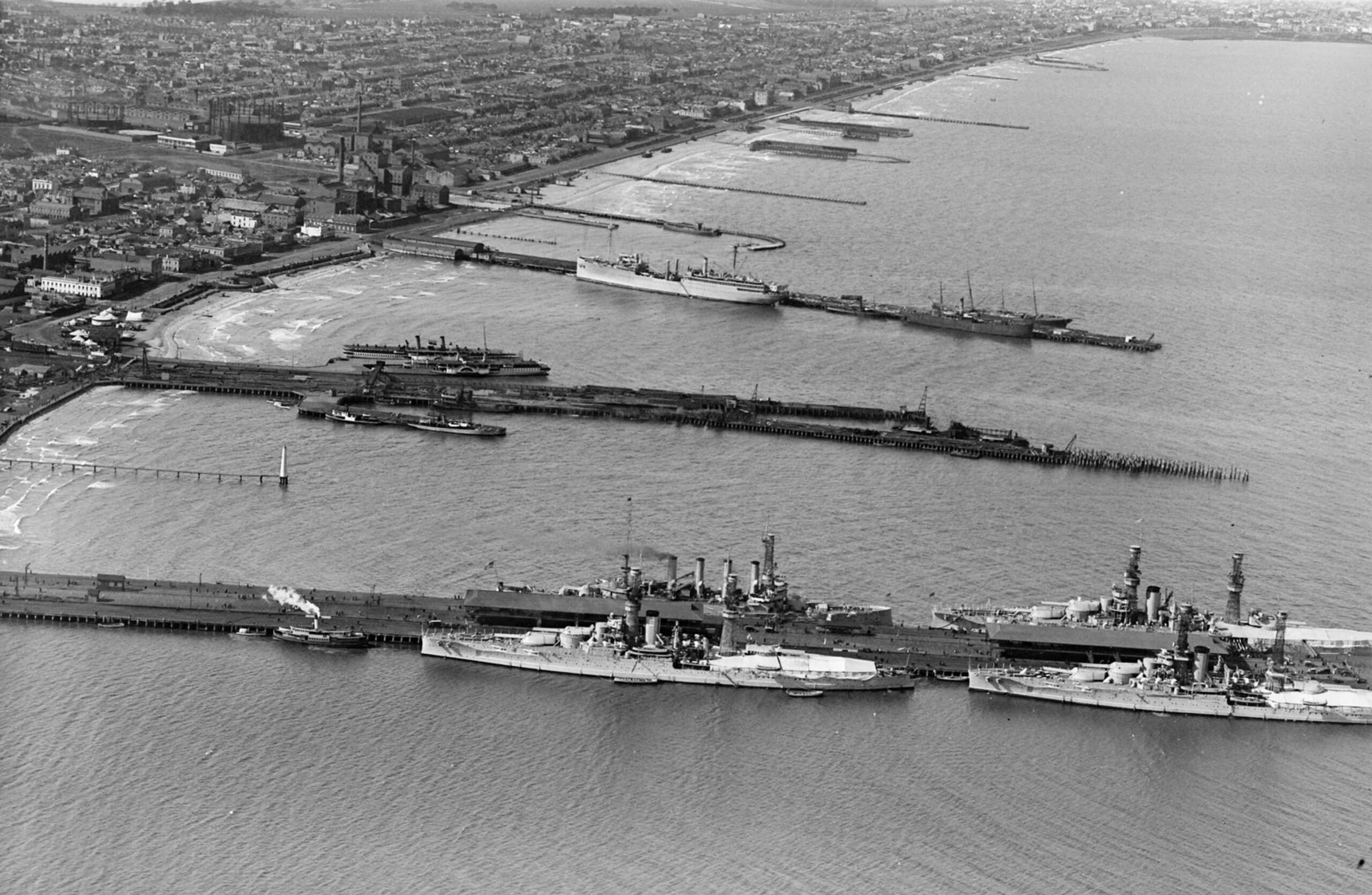
Hansom demonstrated the effectiveness of his new camera mechanism when photographing the battle cruisers HMS Hood and Repulse and other vessels of the Special Service Squadron when they docked at Princes Pier in March 1924. On being presented with a framed set of aerial images of his ships, British Vice Admiral Sir Frederick Field, commander of the squadron, described them as “magnificent”. The image below, one of the many photos Hansom took of the visiting ships, gives a sense of the drama he could create aided by the flying skills of Harry Shaw.
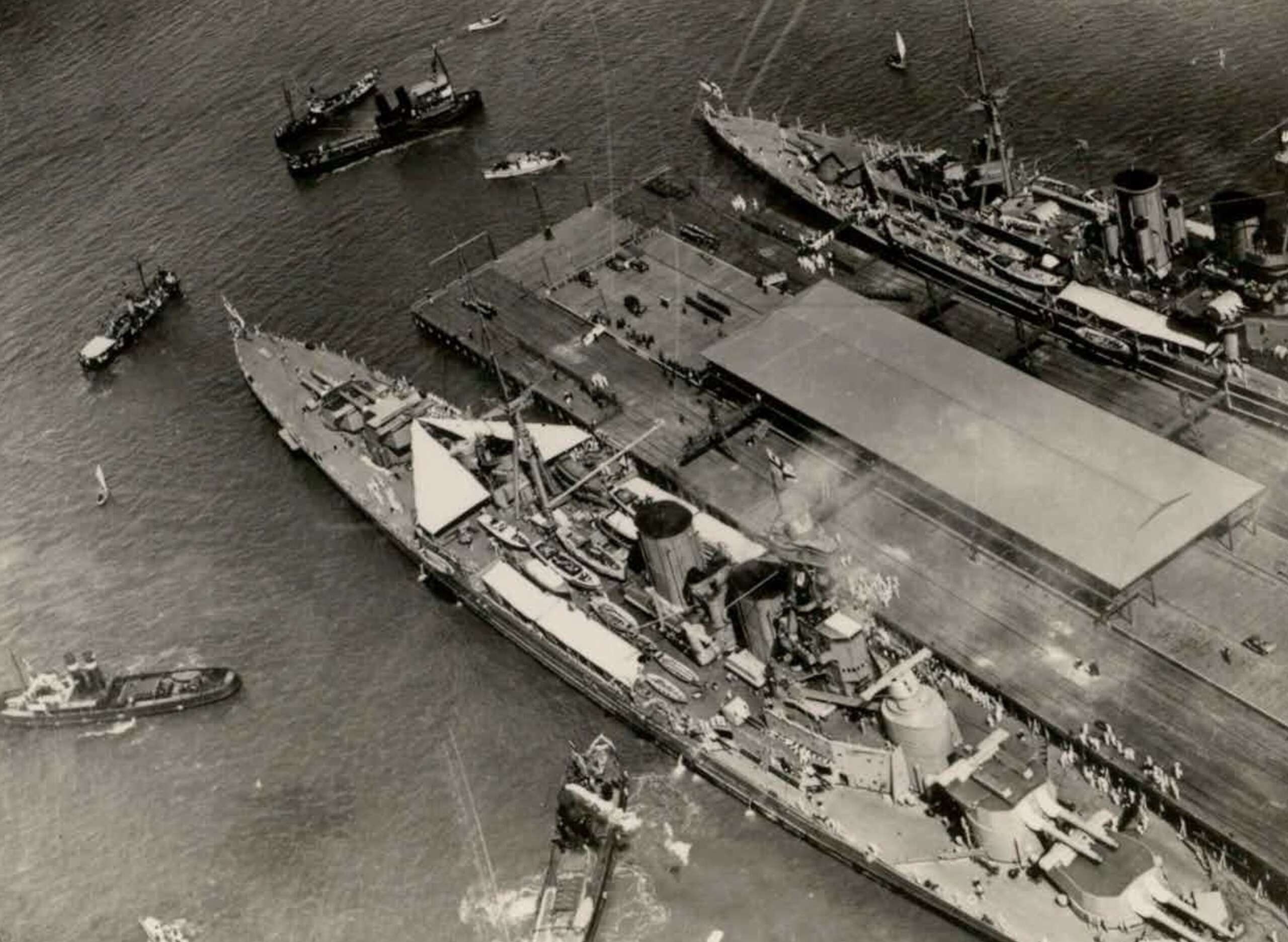
Panoramic aerial photos of Port Melbourne by Bill Hansom offer contrasting perspectives depending which direction he pointed his camera. The image below highlights the sparsely developed Fishermans Bend foreshore near Princes Pier, with Railway Pier and Town Pier beyond. The Anglo-Persian Oil Company / Commonwealth Oil Refineries storage tank at the head of Princes Pier was completed in mid-1922. The absence of the leading lights, built in 1924, suggest the photo was taken around 1923.
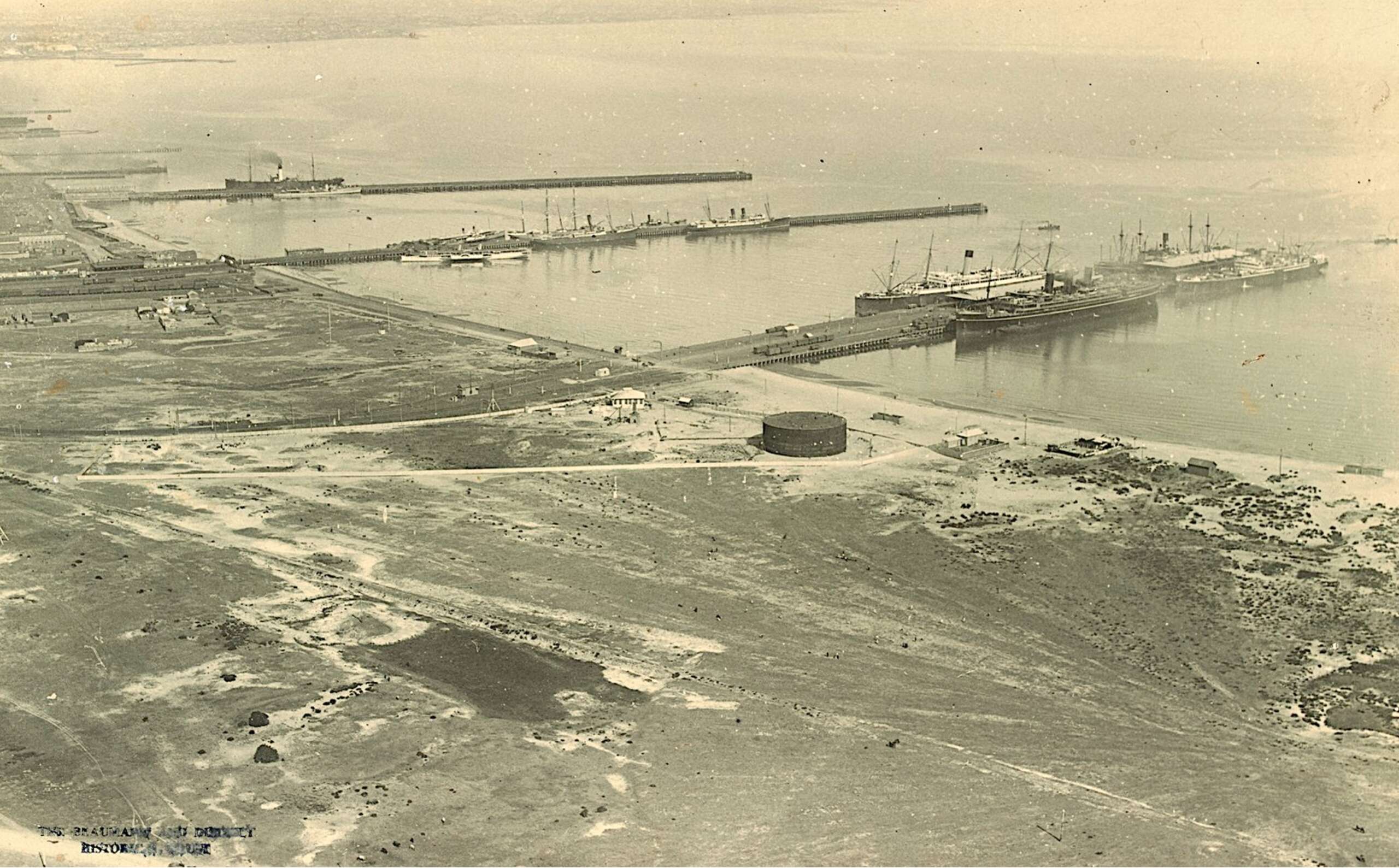
The aerial photo below, taken a year or two later, gives an altogether different impression. Looking eastward, from above Princes Pier, it highlights the bustling commercial and industrial foreshore of Port Melbourne and the densely packed housing beyond in Albert Park. The leading lights are now in place and the morphing of Railway Pier into Station Pier is underway. Yet, the sandy expanse of Fishermans Bend in the previous image remains as was, it is just not visible from this angle.
From early 1925, the aerial photos taken by Bill Hansom from Harry Shaw’s plane, including this one, were published under the byline “Airspy”.[10] Thanks to social media, the photos they took of Port Melbourne and surrounds, the Melbourne CBD, famous sporting grounds, and regional Victoria a century ago are familiar to many today.
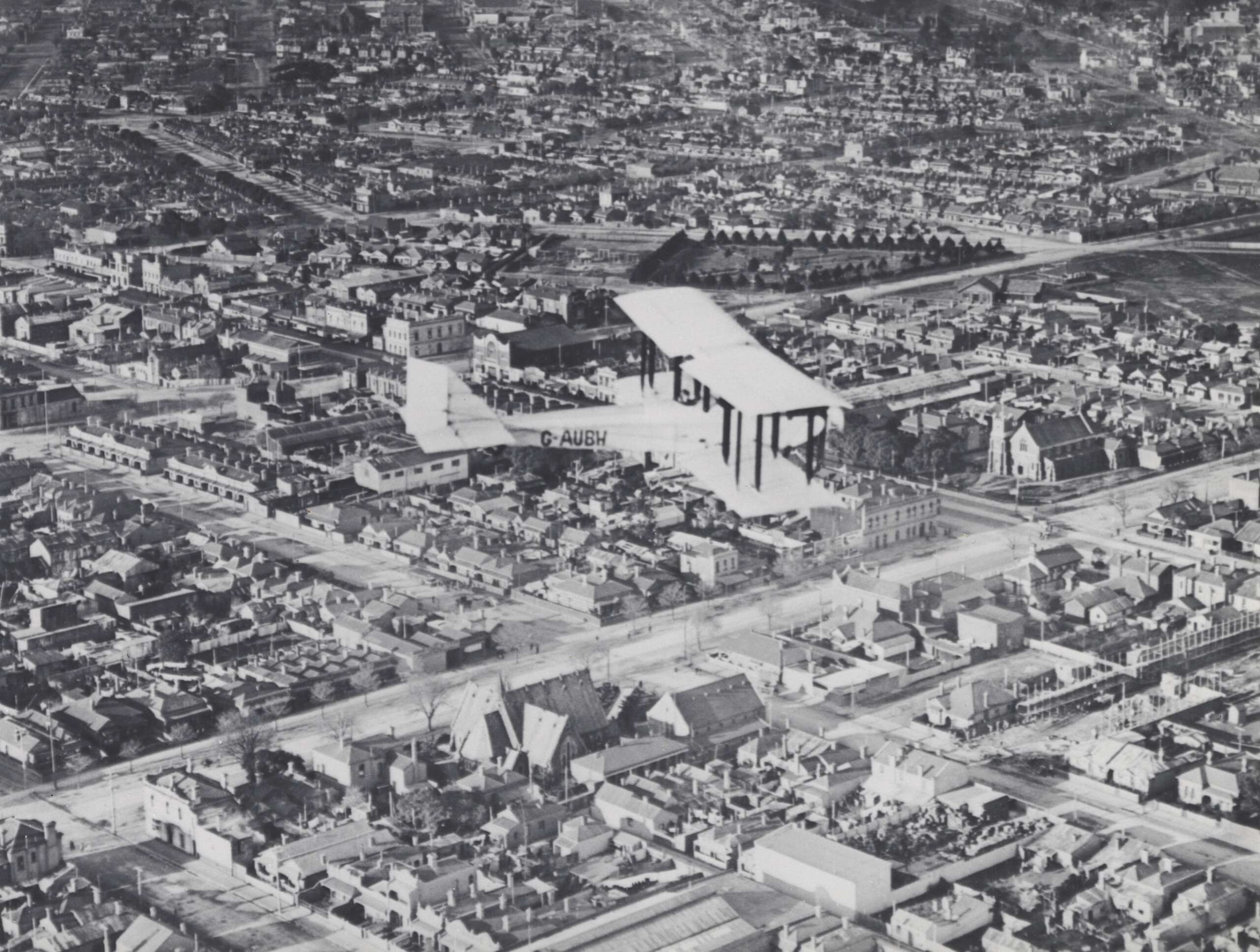
Occasionally, a “new” Airspy image comes to light, like the one below. It shows a de Havilland DH 6, part of Harry Shaw’s stable, flying over Graham Street between Nott and Bay Streets, Port Melbourne. The Graham Street Wesleyan church complex features prominently in the foreground. Reproduced here courtesy of the Royal Historical Society of Victoria, this photo was taken “in the 1920s” by Bill Hansom from a Farman Sports flown by Harry Shaw. Close examination of details in the photo suggest it was taken around 1928.
Flying in a post-war surplus aircraft was hazardous. Reflecting on his adventures as an aerial photographer, Hansom recalled a narrow escape in the early days flying with R.G. Carey. Over Collingwood to photograph the site for a proposed factory, the plane’s carburettor failed and the engine stopped. He vividly recalled a chimney passing by his face, then rocks and trees ahead as they came down towards the Yarra. Luckily, Carey landed safely in a paddock on the Fairfield side of the river.[11]
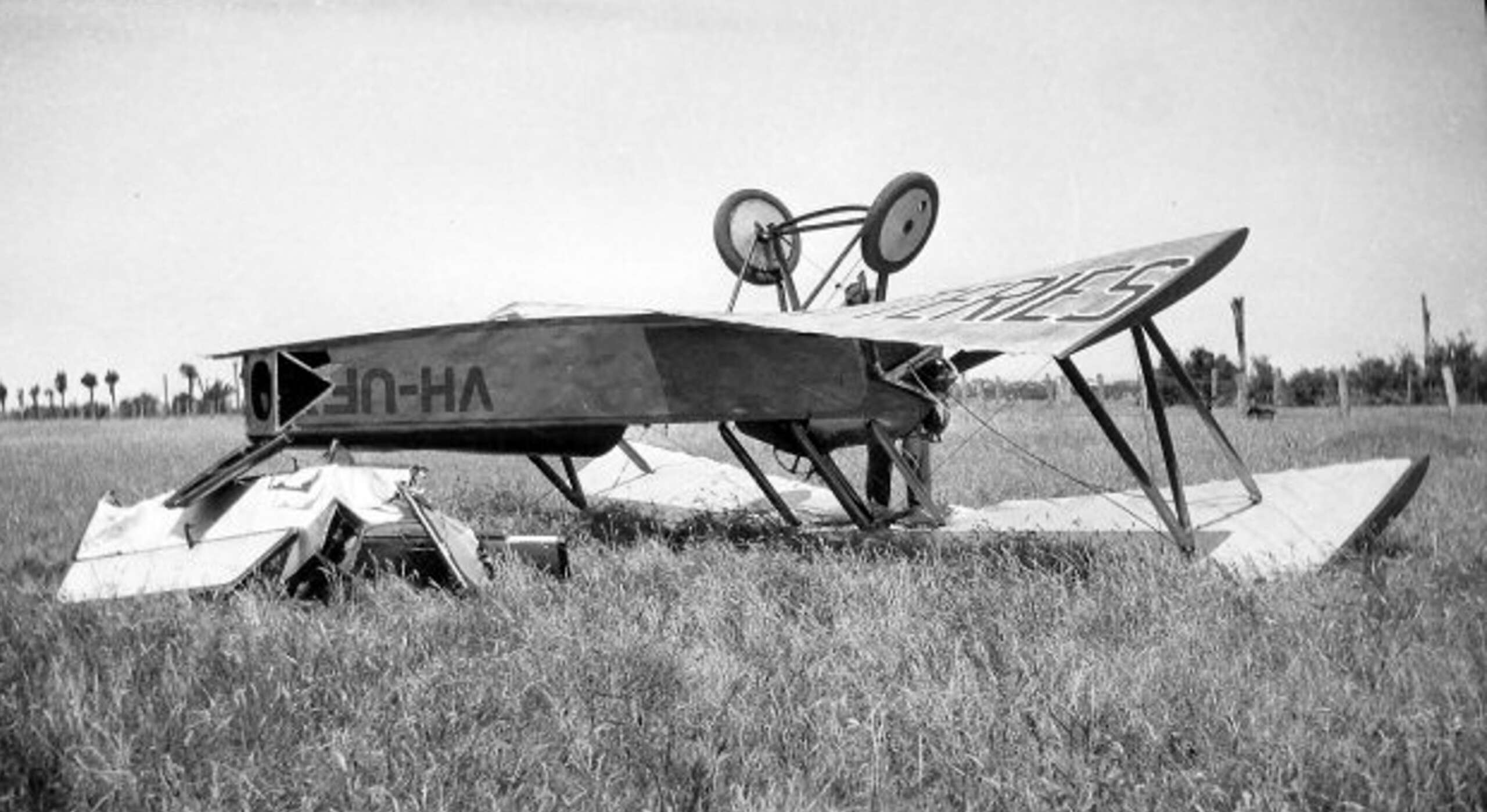
Then, in 1930, he and Harry Shaw crashed at Essendon when the plane’s engine stalled as they approached the field. Although both men were flung from the upturned plane (shown below), newspaper reports said neither was hurt.[12] However, Hansom said later that he was rendered unconscious in the accident and had double vision for the next six months. [13]
Bill Hansom passed away in 1939, aged 77.[14] However, the aerial photography continued under the name Airspy thanks to pilot/photographer Charles Daniel Pratt.[15] It is not clear if Pratt worked with Hansom in the late 1930s or if he simply acquired the rights to the moniker Airspy after Hansom’s death.
The State Library Victoria holds over a thousand fascinating aerial photos by W.H. Hansom as Airspy. Those by Charles Pratt taken before 1940 are catalogued under his name and as Airspy (Firm) after that.
[1] 1921 ‘Sport and Sportsmen’, Smith’s Weekly (Sydney, NSW : 1919 – 1950), 15 January, p. 8., viewed 08 Jun 2026, http://nla.gov.au/nla.news-article234270007
[2] NAA: A1861, 4534 Photograph. “Port Melbourne and Albert Park From the Air”. Registration and Exhibit. Copies of this image also exist in several collections.
[3] 1932 ‘A Flying Photographer’, The Argus (Melbourne, Vic. : 1848 – 1957), 3 September, p. 6. , viewed 08 Jun 2026, http://nla.gov.au/nla.news-article4495906
[4] 1909 ‘Personal.’, Table Talk (Melbourne, Vic. : 1885 – 1939), 16 September, p. 7. , viewed 08 Jun 2026, http://nla.gov.au/nla.news-article145852394
[5] 1905 ‘BILLIARDS.’, Leader (Melbourne, Vic. : 1862 – 1918, 1935), 5 August, p. 18. , viewed 09 Jun 2026, http://nla.gov.au/nla.news-article198195892
[6] 1920 ‘What People are Saying and Doing’, Table Talk (Melbourne, Vic. : 1885 – 1939), 1 April, p. 6. , viewed 09 Jun 2026, http://nla.gov.au/nla.news-article146689824
[7] 1916 ‘MORNING MISTS.’, Weekly Times Annual (Vic. : 1914 – 1918), 4 November, p. 21. , viewed 08 Jun 2026, http://nla.gov.au/nla.news-article132754903
[8] Desmond Martin and Bertha Carey (2004), A Message from the Clouds: A Biography of Robert Graham Carey – Australian Pioneer Aviator,Publishing Services, pp. 128.
[9] 1924 ‘NEW AERIAL CAMERA.’, The Argus (Melbourne, Vic. : 1848 – 1957), 2 April, p. 8. , viewed 09 Jun 2026, http://nla.gov.au/nla.news-article1906649
[10] The name “Airspy” eludes to the pilots in WW1 who flew over the trenches to photograph enemy positions and movements.
[11] 1932 ‘A Flying Photographer’, The Argus (Melbourne, Vic. : 1848 – 1957), 3 September, p. 6. , viewed 10 Jun 2026, http://nla.gov.au/nla.news-article4495906
[12] 1930 ‘PLANE CRASH’, The Sun (Sydney, NSW : 1910 – 1954), 19 November, p. 11. (LAST RACE), viewed 08 Jun 2026, http://nla.gov.au/nla.news-article225342354
[13] 1932 ‘A Flying Photographer’, The Argus (Melbourne, Vic. : 1848 – 1957), 3 September, p. 6. , viewed 10 Jun 2026, http://nla.gov.au/nla.news-article4495906
[14] 1939 ‘Obituary MR. W. H. HANSOM’, The Argus (Melbourne, Vic. : 1848 – 1957), 8 November, p. 8. , viewed 09 Jun 2026, http://nla.gov.au/nla.news-article11279255
[15] 1941 ‘Flying Figures Back at Service Schools’, Air Force News (National : 1941), 3 May, p. 2. , viewed 09 Jun 2026, http://nla.gov.au/nla.news-article259479804