J Kitchen and Sons: maker of industrial chemicals
Over its long history the company used a range of titles, but to the residents of Port Melbourne it was never anything other than ‘Kitchens’1.
Kitchens meant Velvet Soap and a memory of candles, but to the wider manufacturing community it had quite another connotation: as a major manufacturer of fatty acids. In the early 1960s Kitchens produced a folder, Chemicals for Industry (PMHPS Collection Cat No 3345), giving details of their chemical products available to other industries and the ways they could be used. All of these were made at the factory in Ingles Street except glycerines that were distilled at the Balmain works in New South Wales.
For example: ‘Kitolene 011’ and ‘Kitolene 032’ were used in liquid soap, printing ink, liquid polish and shampoo. The stearine ‘Kitsterene 601’ could be an ingredient in the making of products as varied as cement waterproofing, rubber, polishing compounds and crayons. The viscous liquid ‘Kitstilate 281’ was used in the manufacture of chip board while ‘Kitstilate282’ was a soil stabilser.
Although no information is given about who bought these products, it is possible that one of them, Lubricant K18, went no further than the Dunlop works just down the road: This is used a “slick” to coat rubber sheets to prevent their sticking together. The product is normally used diluted 1 part lubricant to 4 part water.
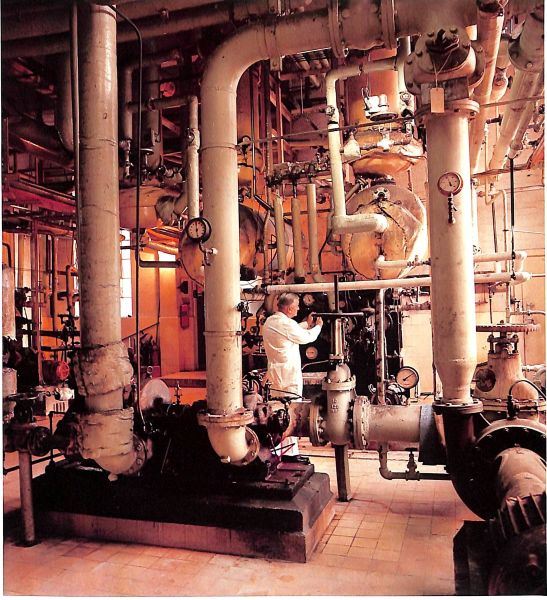
The first step in the production of these refined fatty acids is the separation of oleine and stearine. Kitchens was the first candle making company in Australia to use this process on a commercial basis, giving them a competitive edge on rival candle makers. It was their ability to use this process on a grand scale that later led to their role as significant industrial suppliers of fatty acids. The photograph below shows the machinery used for this process in 1962.
The growth and diversification of the Kitchens company can largely be attributed to John Ambrose Kitchen, eldest son of founder John Kitchen. He pursued a policy of expansion and established cooperative arrangements, two of the most important were the amalgamation with the Apollo Candle Works in 1885 and the association with the British firm Levers that commenced in 1914, leading eventually to a merger 1925.
The anonymous author of Chemicals for Industry describes their position in 1960:
“A company geared up for intensive chemical specialisation is J. Kitchen & Sons Pty Ltd. More than 120 years ago Kitchens began operations and now we are well known in the chemical industry as manufacturers of fatty acids, oleines, stearines , oleo chemicals, glycerines and a host of specialised chemicals. The facilities employed to produce the range of fatty acids, oleines and stearines include high pressure splitting units, vacuum separation units, an Emerald solvent separation unit and a unit capable of hydrogenating fatty acids.”2
In addition to producing chemicals in Australia to sell to Australian industry, their overseas connections, not only with the Lever companies but also as agents for other English firms as well as Canadian, German, Dutch and South African enterprises, made Kitchens a significant part of the chemical industry in Australia.
1 this colloquial spelling is used throughout
2 Note that there are no page numbers in this publication
This article was drawn from material in the folder, Chemicals for Industry, held in the Society’s collection.
To find out more about Kitchens
Read J. Kitchen and Son, the candle kings where comments from readers have added depth to the story.
Visit the display Working Life in Port Melbourne: J Kitchen and Son, 1859 to 2013 at the Port Phillip Heritage Centre in Bank St, South Melbourne. It’s on until 24 March