Walter Avenue
by David F Radcliffe
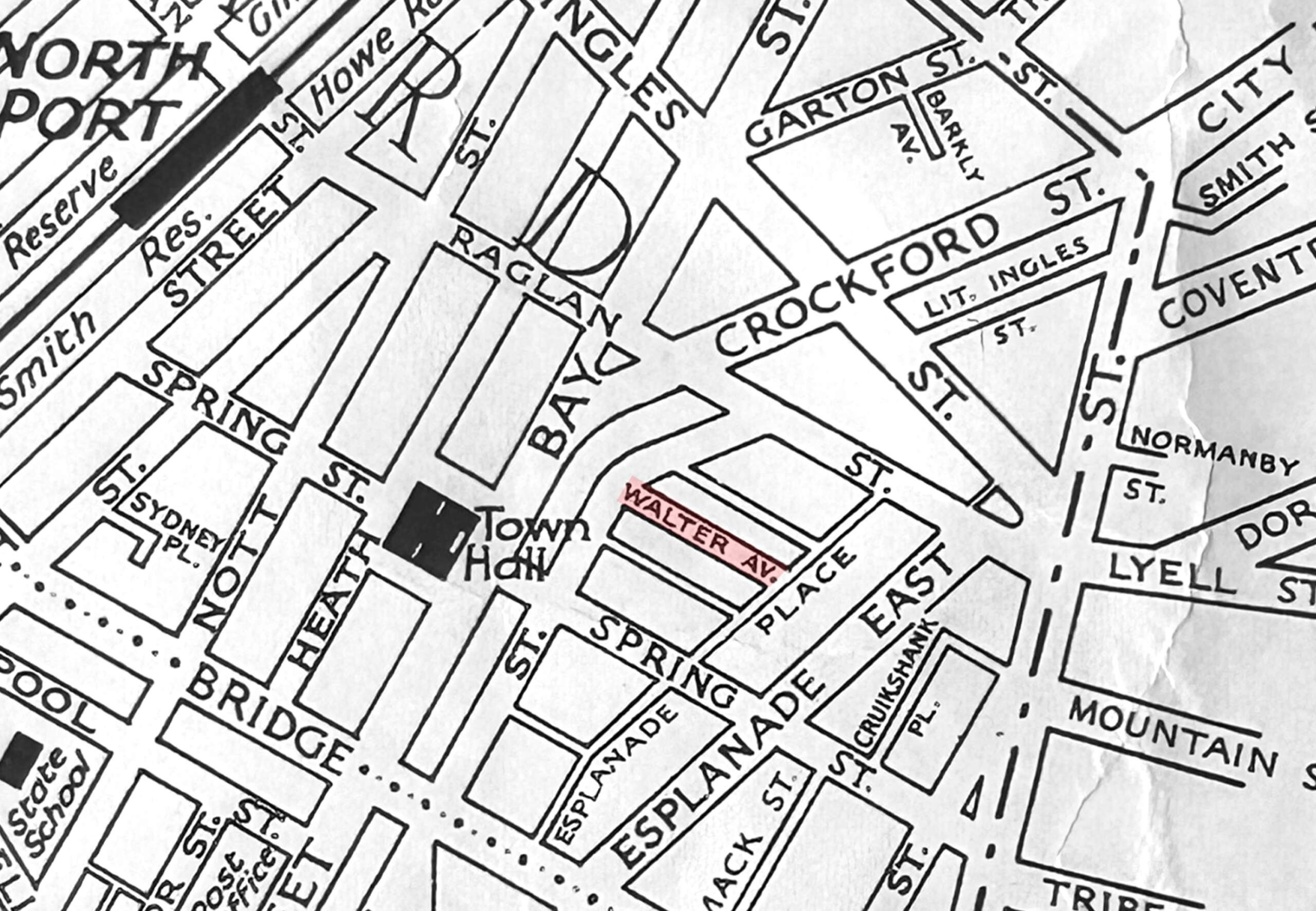
For sixty years, Walter Avenue ran between Lyons Street and Esplanade Place. It honoured George Samuel Walter (1875-1937) who served continuously as a Port Melbourne Councillor from 1897 to 1937. He died in office. G. S. Walter was twice mayor (1901/02 and 1934/35) and a Commissioner on the Melbourne and Metropolitan Board of Works (MMBW) from 1907 until his death. The history of this short roadway encapsulates many elements of the story of Port Melbourne.
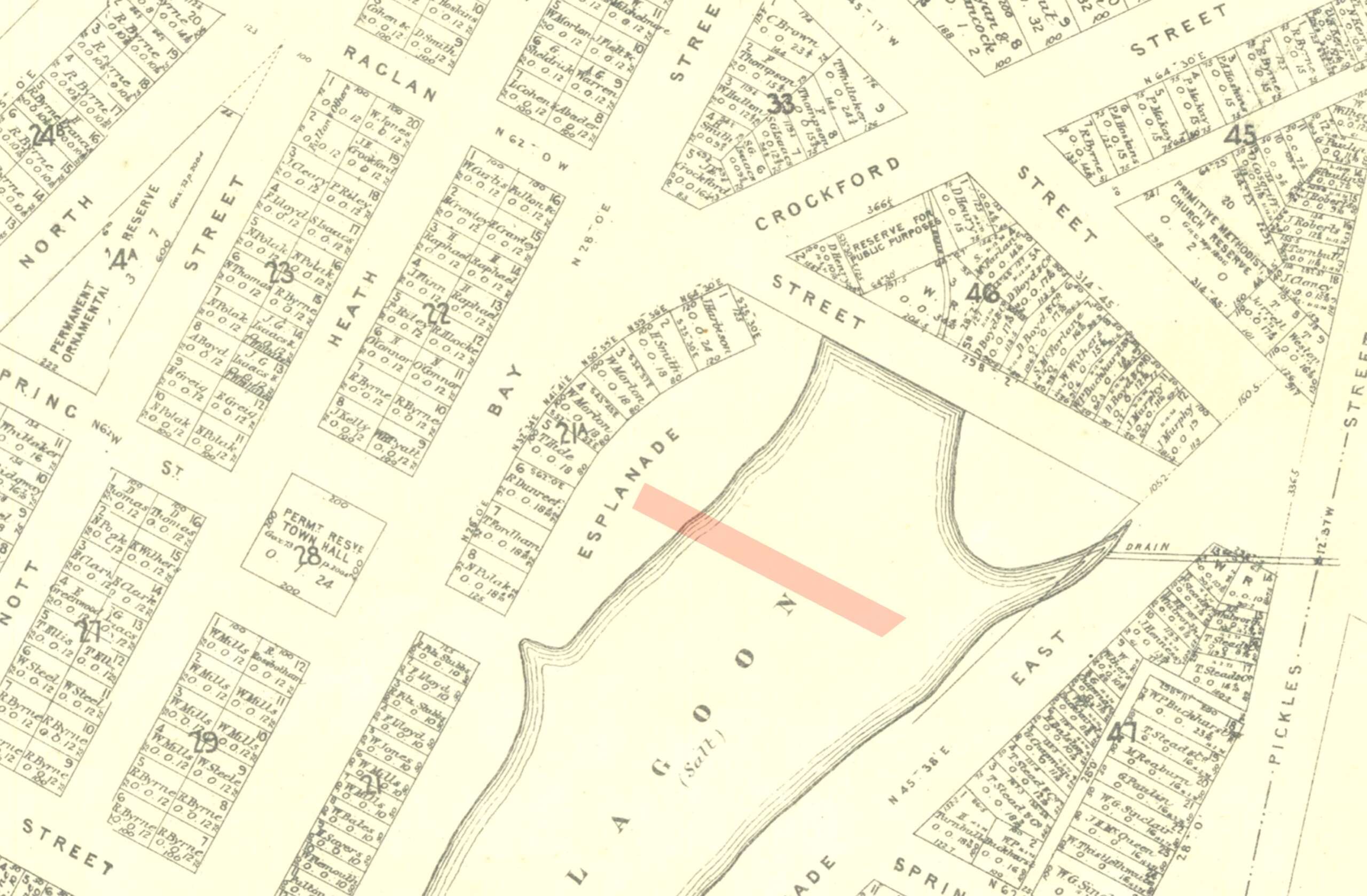
Walter Avenue traversed land reclaimed from the upper reaches of the former Sandridge Lagoon. Until the end of the 1860s, the Lagoon formed the eastern extent of the settlement of Sandridge. This changed during the 1870s, with land subdivision taking place on the eastern shore of the Lagoon as far as Pickles Street, the municipal boundary with South Melbourne. A program to progressively fill in the upper reaches of the Lagoon, between Bridge and Raglan Streets, began in the late 1870s. By the early 1880s, newly formed sections of Bridge and Spring Streets linked the communities on opposite sides of the Lagoon.
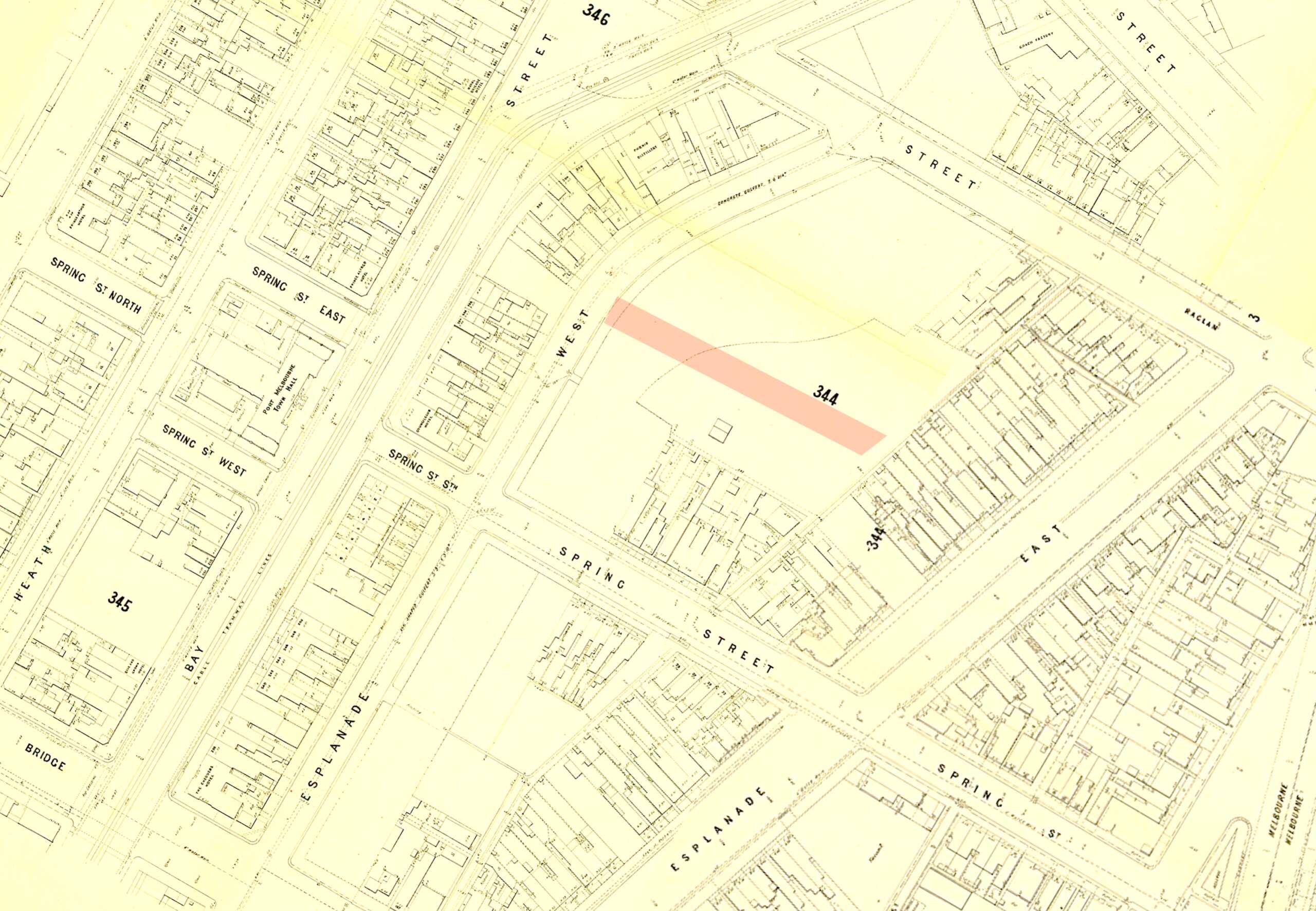
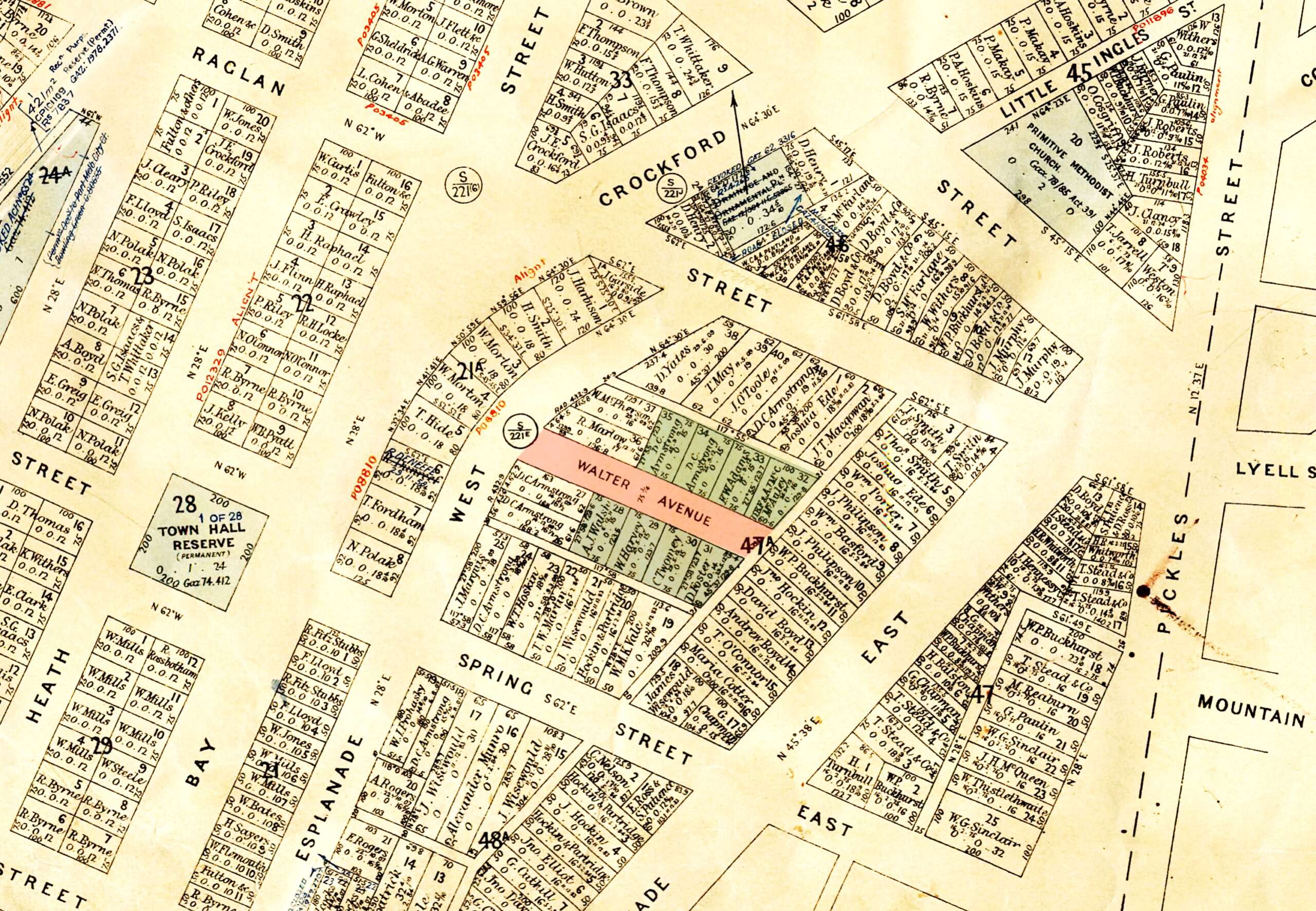
Speculators snapped up those parts of the reclaimed land along the eastern side of the former Lagoon at auctions in December 1883 and February 1884.[i] Modest, wooden workers cottages sprung up quickly, as the map below shows. This was the height of a massive real estate boom, the decade referred to as Marvellous Melbourne.[ii] Auctions for the remaining reclaimed land, along Esplanade West (later Lyons Street) between Raglan and Bridge Streets, took place between 1907 and 1909.
At auctions held in May and September 1912, the Crown disposed of the remaining reclaimed land at the centre of what had been the Lagoon, the area shown in green in the map below, on either side of what became Walter Avenue. Not yet gazetted, in July 1914 complaints about this new roadway becoming a rubbish tip were discussed at the Port Melbourne Council.[iii] That December, they approved the funds to properly form, seal and channel Walter Avenue.[iv] Yet, only one house was built on it, that of William Harvey.
Instead, Walter Avenue became a place of industry and commerce. Initially, there was the case making works of Cornelius Twomey plus the stables and yards of brothers Thomas and John Walsh and that of John Allnutt, two firms of carriers.[v] In September 1916, one of the Allnutt’s wagons crashed into a recently installed electricity transmission pole at the corner of Lyons Street causing a power blackout across much of North Port.[vi] Patrons at the Fountain Inn, Naval Brigade Hotel, Prince Alfred Hotel, Rose and Crown and Chequers Inn reverted drinking by the light of candles and oil lamps.[vii]
Despite forty years of development erasing all traces of the upper reaches of the Lagoon, it reappeared with vengeance on the evening of Tuesday 4 March 1919.[viii] Steady showers gave way to a torrent of rain around midnight with the volume of water so large that the pumping station in Esplanade West near Rouse Street, installed twenty years earlier as part of the Lagoon reclamation and drainage scheme, was unable to cope.
By one o’clock, lakes of storm water were forming themselves in Spring Street and at the corner of Ingles and Bay Streets. Later lochs spread out of the channels across Esplanade West (now Lyons St) along McCormack Street over Walter Avenue, Crockford Street and other thoroughfares in the neighbourhood. At 2 o’clock a sea of water spread across Spring Street as far to the northward as a point halfway between the Floodgate Hotel and Pickles Street.
Many properties were inundated. Police on the night shift went door to door to wake people. Those unable to get out on foot were rescued by horse and cart and taken to the Town Hall where they dried off and were given a warm drink.
A couple of weeks after this deluge, the Council approved an application by the McAuley Brothers to erect a factory on the northern side of Walter Avenue near Esplanade Place for their expanding business as coppersmiths, plumbers, gas fitters, and hot water engineers. Their story parallels that of Walter Avenue.
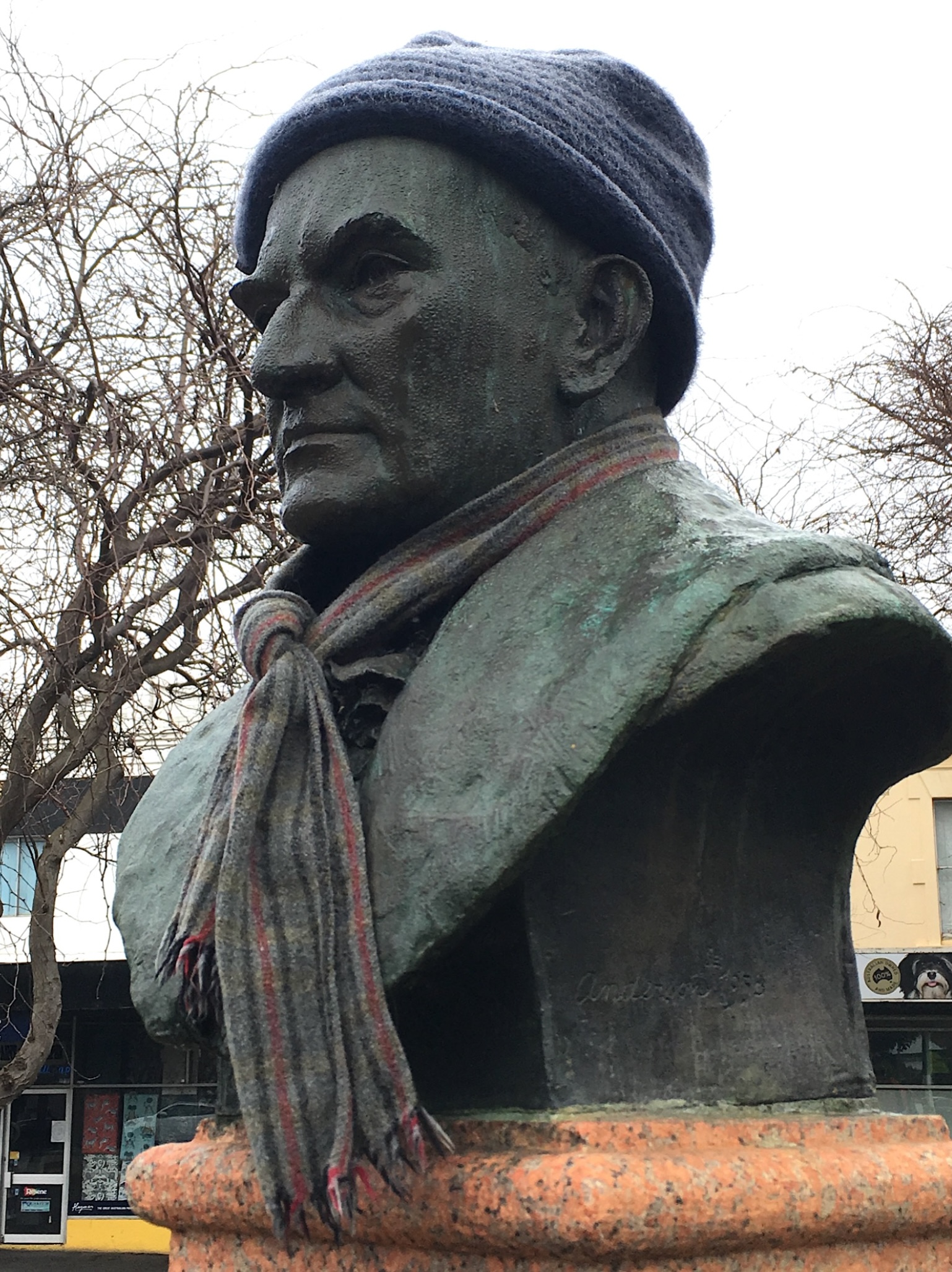
Councillor Walter has the distinction of having three other pieces of local infrastructure named after him: – Walter Reserve (1911), Walter Street (1928) and the George Samuel Walter Memorial Garden (1938) featuring a larger than life bust of him. In 1930, a celebratory function held at the Town Hall lionised him as a pioneer of the Labor movement in local government.[ix] Upon his death, a headline in the Record described him as one of Port Melbourne’s “most brilliant sons”.[x] The paper’s extensive obituary and account of his funeral speaks to the deep sense of loss felt; a constant presence in civil life suddenly gone.
Yet, notwithstanding the many physical reminders of him around the district, he is not as prominent in the story of the Borough as might be expected. His bust at the memorial gardens on Crockford Street causes curious passers-by to pause and read of his accomplishments. Some even lend him assistance against the bitter winds of winter.
In the late 1970s, Walter Avenue became Davies Street, named for A. E. (Bert) Davies, another mayor whose story is not widely known today. Some say this change was to avoid confusion. Yet Walter Avenue and Walter Street co-existed for fifty years prior to the change, so why was there suddenly a problem? A common theme across Port during the closing decades of the 20th century was apartment buildings and other housing developments displacing industrial premises. So perhaps the name change anticipated the former Walter Avenue becoming a street full of stylish townhouses in the 1990s.
[i] David F. Radcliffe (2021), Changing Fortunes: Ebb and Flow of People and Place in a Pocket of Port Melbourne, PenFolk, Blackburn.
[ii] Graeme Davison (1978), The Rise and Fall of Marvellous Melbourne, Melbourne University Press, Melbourne.
[iii] 1914 ‘STREET AS A TIP.’, Port Melbourne Standard (Vic. : 1914 – 1920), 25 July, p. 2. , viewed 24 Mar 2026, http://nla.gov.au/nla.news-article91164052
[iv] 1914 ‘LOAN PROPOSAL.’, Port Melbourne Standard (Vic. : 1914 – 1920), 26 December, p. 2. , viewed 25 Mar 2026, http://nla.gov.au/nla.news-article91166694
[v] Sands and McDougall Directory of Victoria, 1915-1920
[vi] Electricity came to Port Melbourne in 1912 and was supplied by the Council.
[vii] 1916 ‘COLLISION CUTS OFF CURRENT.’, Port Melbourne Standard (Vic. : 1914 – 1920), 23 September, p. 3. , viewed 25 Mar 2026, http://nla.gov.au/nla.news-article91165568
[viii] 1919 ‘THE FLOOD.’, Port Melbourne Standard (Vic. : 1914 – 1920), 8 March, p. 3. , viewed 26 Mar 2026, http://nla.gov.au/nla.news-article165262036
[ix] 1930 ‘HONORING A PIONEER’, The Record (Emerald Hill, Vic. : 1881 – 1957), 20 September, p. 4. , viewed 26 Mar 2026, http://nla.gov.au/nla.news-article164965164
[x] 1937 ‘PORT MELBOURNE SUFFERS BY DEATH OF CR. G. S. WALTER’, The Record (Emerald Hill, Vic. : 1881 – 1957), 28 August, p. 5. , viewed 26 Mar 2026, http://nla.gov.au/nla.news-article164489328
2 Comments
Glen Cosham
By the 1970s, virtually every home had a telephone. When residents of Walter Street phoned for a taxi, cabs would often go to Walter Avenue. The same thing happened when cabs arrived at Edwards Street, instead of Edwards Avenue. To overcome this confusion and at the same time recognize two former Mayors who did not have streets named after them, Davies and Morley Streets came into being.
David Radcliffe
Thank you for this explanation as to why these two pairs of streets with near identical names needed to be changed in the 1970s, even though they had co-existed without apparent issue for nearly 60 years to that time. The impact of new technology.